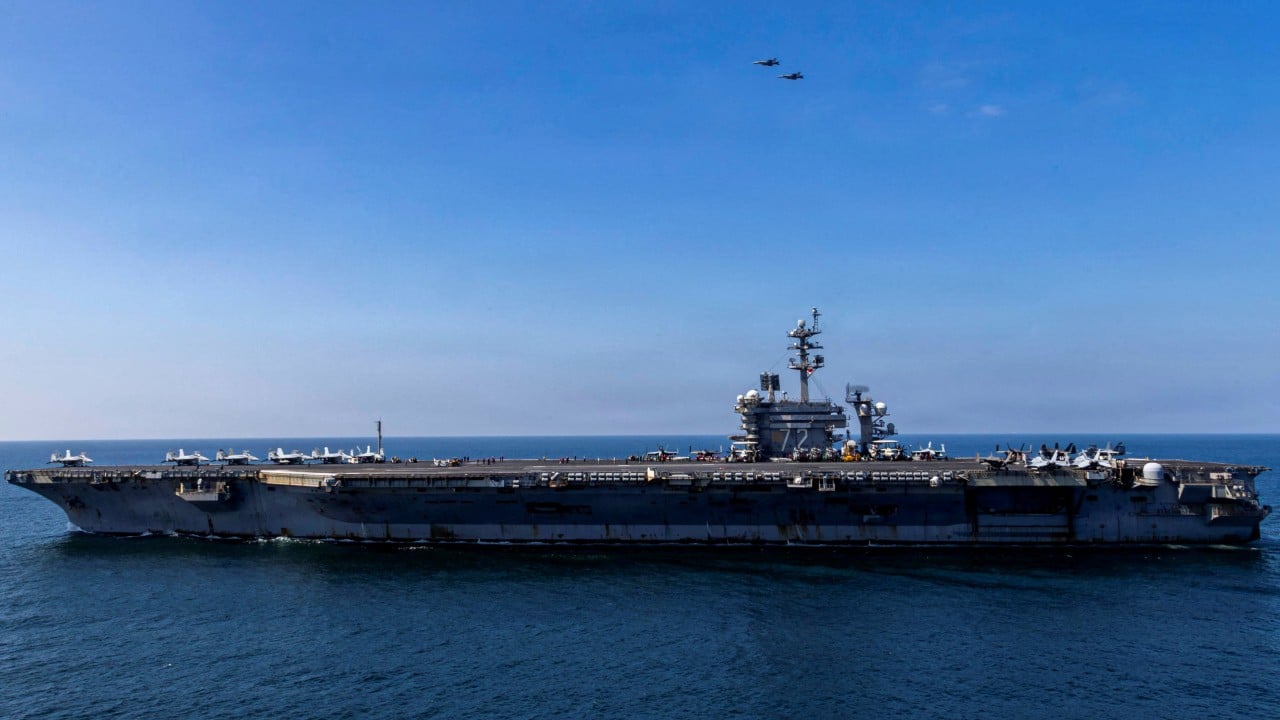
Naval aviation at sea operates on a knife-edge between mechanical throughput and human endurance. When the USS Abraham Lincoln became the subject of public scrutiny regarding severe onboard conditions, mainstream reports framed the breakdown as a series of isolated grievances regarding sanitation, water quality, and maintenance delays. That framing misses the structural reality. An aircraft carrier is a closed-loop industrial city operating in a high-entropy environment. When quality of life degrades, it is rarely the result of localized negligence. Rather, it indicates systemic friction within a complex supply chain, maintenance backlog propagation, and organizational throughput limits.
Evaluating the operational reality of a Nimitz-class carrier requires stripping away anecdotal complaints to examine the governing metrics: operational tempo, supply chain latency, potable water generation capacity, and habitability degradation curves.
The Operational Tempo Equation
The baseline stressor on any deployed carrier is the divergence between expected utilization and actual asset availability. A carrier strike group operates on a Optimized Fleet Response Plan, a cycle designed to balance deployment, maintenance, and training. When geopolitical friction forces extensions or surge deployments, the mathematical model breaks down.
The primary driver of onboard distress is the operational tempo coefficient. Every flight deck launch and recovery cycle requires precise thermal, mechanical, and human inputs.
- Maintenance Backlog Accumulation: As operating hours exceed design thresholds, preventative maintenance windows compress. This creates a compounding deficit where minor mechanical faults evolve into critical system failures.
- Logistics Friction: Replenishment at sea operations depend on predictable sea states and tanker availability. When operational demands outpace replenishment schedules, consumables including food stores, spare parts, and potable water face rationing thresholds.
- Throughput Bottlenecks: Living spaces designed for a specific complement experience density spikes when temporary augmentees, maintenance detachments, or security elements are added without a corresponding expansion in life-support infrastructure.
When these variables compound, the internal environment shifts from a high-performance workplace to an attrition-driven holding pattern.
The Mechanics of Environmental Degradation
Habitability issues on a nuclear-powered vessel are fundamentally engineering challenges governed by thermodynamics and fluid dynamics. Reports concerning compromised sanitation systems and erratic potable water access point to specific infrastructural strain points.
A carrier generates its own fresh water through multi-stage flash distillation or reverse osmosis plants, utilizing heat from the nuclear reactors or electrical power. These systems require continuous, highly technical maintenance. When a carrier is running at maximum operational tempo, engineering departments are often forced to triage priorities. Propulsion and flight deck systems take precedence over auxiliary hotel services such as waste management and environmental control units.
- The Sanitation Bottleneck: Marine sanitation devices rely on complex vacuum and gravity drainage networks spanning multiple decks. A single obstruction or localized loss of vacuum pressure can disable entire berthing compartments, cascading sanitary failures throughout the zone.
- Thermal Regulation Deficits: High-density berthing spaces generate substantial body heat and moisture. When ventilation and air conditioning systems experience reduced efficiency due to fouled coils or power distribution limits, ambient temperatures rise, directly impairing crew cognitive function and sleep quality.
- Nutritional Logistics: Feeding thousands of personnel three times a day requires precise cold-chain management and high-volume galley operations. Equipment failures in walk-in refrigeration units immediately force a pivot to shelf-stable rations, degrading caloric intake quality and lowering morale.
These failures do not occur in a vacuum. They are symptoms of deferred maintenance that has crossed the threshold from invisible risk to visible crisis.
Organizational Fatigue and Human Capital Depreciation
Physical degradation accelerates human capital depreciation. Military organizations often rely on the cultural ethos of resilience to absorb structural deficits. However, resilience is a finite resource subject to the laws of diminishing returns.
Chronic sleep deprivation, caused by continuous noise, high ambient temperatures, and broken watch rotations, impairs executive function and situational awareness. In a high-risk environment like an aircraft carrier flight deck, cognitive degradation increases the probability of human error, leading to safety stand-downs, further operational delays, and extended deployment timelines.
The structural feedback loop operates as follows:
- Operational demands prevent scheduled maintenance.
- Equipment failures degrade living and working conditions.
- Degraded conditions reduce crew rest and efficiency.
- Reduced efficiency slows down flight operations and maintenance output.
- Slower output forces extended working hours to meet mission quotas, restarting the cycle.
Breaking this loop requires more than issuing temporary directives or conducting shipboard inspections. It requires a fundamental recalibration of how naval leadership measures operational readiness. Readiness cannot be defined solely by sorties flown or geographic presence maintained. It must incorporate a rigorous accounting of human capital depreciation and asset health indices.
Strategic Realignment of Fleet Management
To prevent systemic failures on capital assets like the USS Abraham Lincoln, naval logistics and command structures must adopt predictive health monitoring for both machinery and personnel.
The traditional reactive posture—waiting for systems to fail or for crew complaints to reach public visibility—guarantees systemic crisis management. True operational reform demands that deployment schedules factor in absolute habitability thresholds. If water generation capacity, sanitation redundancy, or climate control reliability drop below calculated safety margins, the asset must pivot to a maintenance posture regardless of immediate strategic signaling requirements.
Long-term fleet sustainability relies on treating habitability infrastructure not as an auxiliary comfort, but as a core component of combat capability. A crew operating under baseline survival stress cannot execute complex, high-tempo warfare indefinitely. Optimizing naval power requires protecting the human element with the same rigor applied to nuclear reactors and tactical aircraft.