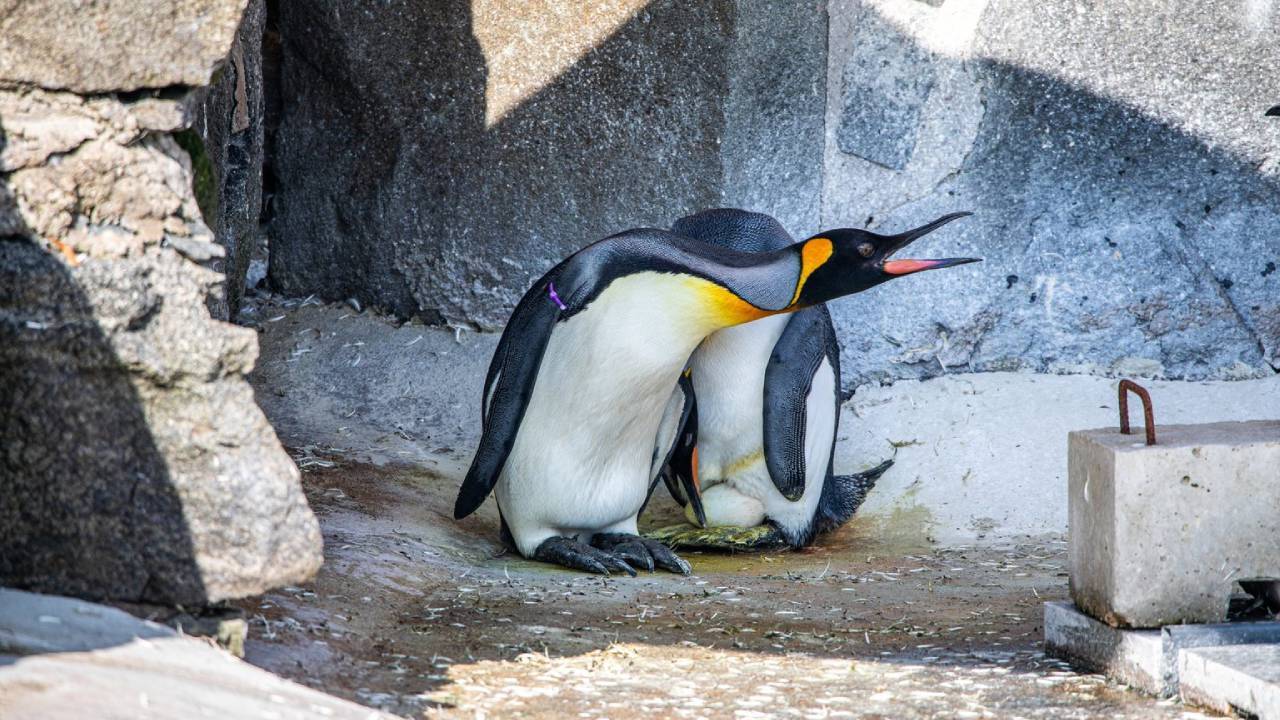
The recent oviposition event at Edinburgh Zoo, resulting in Scotland's first king penguin egg in 17 years, challenges baseline demographic projections for captive colonial seabirds. The biological mechanics behind the egg laid by the female penguin Connie, paired with the high-ranking resident male Major General Sir Nils Olav III, require strict structural deconstruction. Zoo management projected an acclimation timeline extending well into 2027 for newly introduced females that arrived in January. Instead, successful pairing and subsequent fertilization occurred within months, defying standard adaptation lag phases typically observed in multi-year captive colony integrations.
The Chronology of Institutional Lineage
Understanding the reproductive output of Major General Sir Nils Olav III requires separating his unique diplomatic profile from standard ornithological metrics. The lineage functions through a multi-decade institutional framework rather than a single biological entity.
- Foundation Phase (1972): The Norwegian King's Guard established a formal mascot protocol at Edinburgh Zoo, appointing an initial king penguin as lance corporal.
- Succession and Rank Inflation: The title has transferred across three distinct biological specimens, accumulating military promotions conferred by visiting regiments and foreign ministry approvals.
- Current Status: The third iteration holds the rank of major general, functioning as an operational mascot while maintaining standard biological drives inherent to Aptenodytes patagonicus.
Attributing reproductive success to military rank is a narrative device utilized by institutional PR teams, but the underlying mechanisms involve distinct environmental triggers and behavioral synchrony.
The Environmental and Behavioral Variables
King penguins do not build traditional nesting structures. Instead, reproductive efficiency relies entirely on bipedal incubation and micro-habitat selection.
- Thermal Regulation Parameters: The single egg requires an incubation window of approximately 55 days. Because ambient temperatures in northern enclosures differ radically from sub-antarctic environments, strict behavioral shifts are mandatory.
- Parental Shift Coordination: Parents balance the egg on their feet, covered by an abdominal fold of skin, executing continuous weight-transfer protocols to prevent ground contact and subsequent thermal loss.
- Inexperience Risk Matrix: Both specimens represent inexperienced parental profiles within a controlled enclosure. The risk vector centers on drop vulnerability during transfer sequences and potential abandonment if acoustic or visual stressors disrupt the colony perimeter.
The absence of prior reproductive output at the facility for nearly two decades indicates that colony density, age distribution, or sub-group partitioning previously created psychological or spatial bottlenecks. The integration of Connie and her cohort altered the internal social hierarchy, inadvertently accelerating mate selection.
The Incubation Bottleneck and Operational Outlook
The operational focus for the facility now shifts from behavioral observation to embryonic viability tracking. The primary variables dictating success over the next eight weeks involve metabolic consistency and parental hormone stability.
- The Transfer Window: Every movement of the egg between the feet of Sir Nils and Connie represents a high-risk operational vulnerability where thermal drop can compromise cell division.
- Nutritional Demands: Sustaining alternating incubation shifts without foraging freedom requires high baseline fat reserves and precise feeding protocols managed by veterinary staff.
The probability distribution for first-time king penguin parents involves elevated failure rates compared to established breeding pairs. While physiological instincts remain intact, physical coordination during the transfer phase dictates the ultimate survival of the embryo. Management protocols remain focused on passive monitoring rather than direct intervention, preserving natural behavioral feedback loops within the enclosure.

/PeriodicTable-White-58b5d8c15f9b586046df020c.png)

