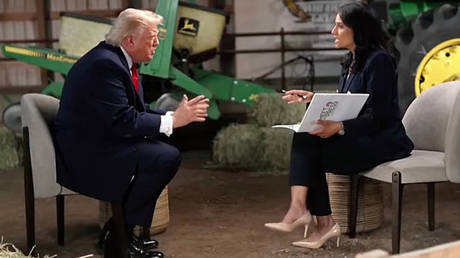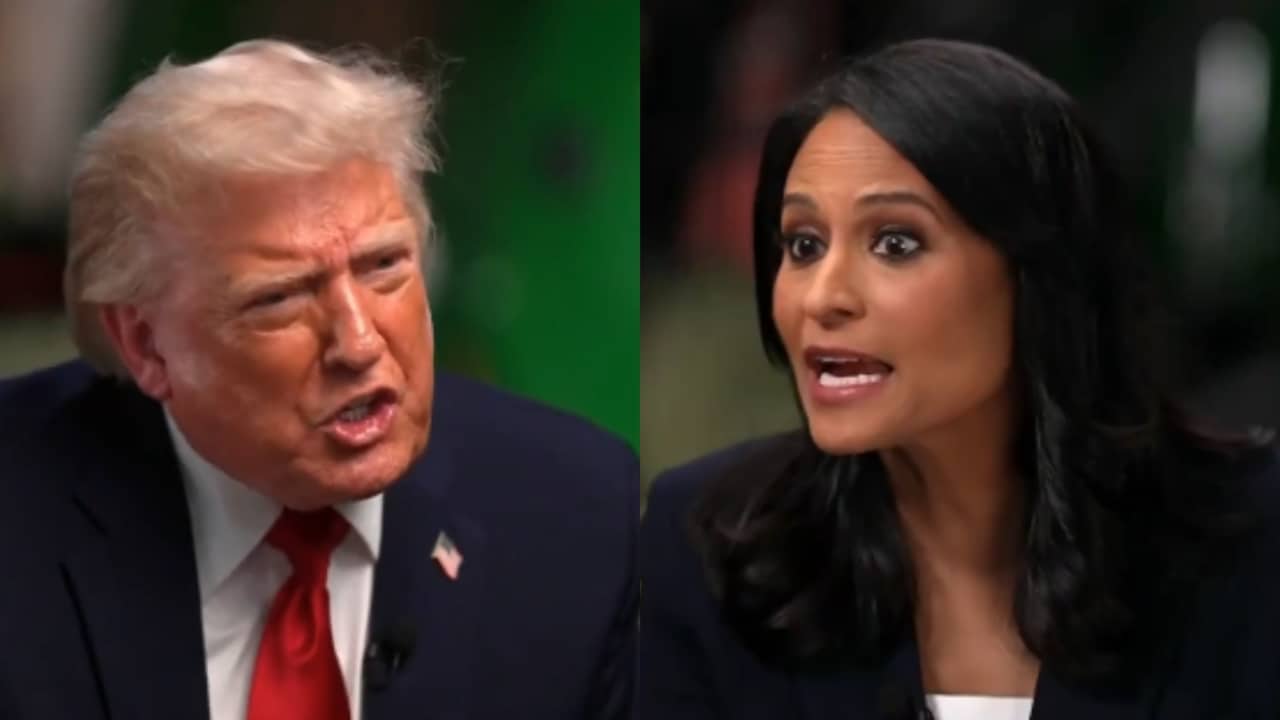
The camera lens is a relentless interrogator. It doesn't blink. It doesn't empathize. It simply records the microscopic shifts in a human face under pressure—the tightening of a jaw, the sudden freeze of a practiced smile, the quiet calculation behind the eyes. For decades, political interviews followed a predictable choreography. A dance of thrust and parry, where both sides knew the steps, respected the boundaries, and played their assigned roles to perfection.
That dance is dead.
What we witness now is something entirely different. It is a blood sport of endurance, where the ultimate prize is not a policy revelation, but a crack in the armor. When Donald Trump abruptly cut short a recent, highly charged interview, uttering the words, "I've had enough. Thank You, Darling," before walking out, the internet reacted with predictable, binary noise. To his critics, it was a meltdown. To his supporters, a justified stand against a hostile ambush.
But leave the political tribalism at the door for a moment. Look closer at the friction itself. What happened in that room carries a much heavier weight than a standard cable news soundbite. It was a visceral demonstration of a broader, systemic collision happening across our culture: the total collapse of shared conversational reality.
The Temperature in the Room
Walk into any high-stakes media environment and you can feel the atmospheric pressure. The air conditioning is usually set to a frigid temperature to counteract the heat of the studio lights, yet the air feels thick, almost heavy. Crew members move in silence. The microphones hang like modern swords of Damocles above the chairs.
In this specific arena, the interviewer wasn't there to throw softballs. The questions came rapid-fire, designed to pin the former president down on specific, controversial timelines and past statements. This is the modern journalistic crucible. It relies on a strategy of relentless accumulation—stacking premise upon premise, refusing to let the subject slide into comfortable talking points.
Consider the mechanics of human frustration. We all have a baseline. We tolerate a certain amount of pushback before our biology takes over. Blood pressure rises. The voice thins. The instinct to defend gives way to the instinct to escape.
For a public figure whose entire brand is built on absolute dominance and control of the narrative, an interview that cannot be steered becomes an existential threat. The moment the questions stopped feeling like a debate and started feeling like a trap, the atmosphere shifted from cold professionalism to pure, unadulterated tension. The invisible stakes weren't just about political points; they were about the preservation of an image.
The Illusion of the Level Playing Field
We like to believe that a televised interview is a fair fight. Two people, two chairs, one conversation.
That is a myth.
The interviewer holds the home-field advantage. They have the research team, the timeline, the list of contradictions, and crucially, the power of the next question. The subject, no matter how powerful, is playing defense from the moment the red light turns on. It is a psychological tightrope walk. One wrong step, one momentary lapse in concentration, and you generate a clip that will be sliced, diced, and weaponized across TikTok and X before the sun goes down.
Let us look at a hypothetical scenario to understand this dynamic away from the blinding light of partisan politics.
Imagine a veteran CEO sitting down with a financial journalist. The company has had a rough quarter. The journalist isn't asking about future innovation; they are hyper-focused on a single, disastrous memo leaked from the HR department three years ago. The CEO wants to talk about the horizon. The journalist wants to dig up the graveyard. After twenty minutes of circular arguing, the CEO realizes that no matter what they say, the headline has already been written in the journalist’s mind.
What do you do when you realize the game is rigged against you?
You refuse to play.
That is the exact inflection point we observed. The realization that words are no longer tools for communication, but ammunition to be used against you. The walkout wasn't just an exit; it was a tactical shutdown. By removing himself from the physical space, the subject attempts to reclaim the power dynamics of the room. If I am not there, you have no show.
The Words Left Behind
"Thank you, Darling."
The phrase hung in the air long after the footsteps faded down the hallway. It was a fascinating, archaic choice of words, dripping with a complex mix of condescension, dismissal, and old-school theatricality. It was designed to disarm the interviewer by reducing her professional persistence to something trivial, shifting the power dynamic one last time before the exit.
This is where the human element becomes fascinatingly transparent. When pushed to the brink, we all revert to our core conditioning. We use the language we know will draw a line in the sand.
But the real problem lies elsewhere, far beyond the confines of that specific television studio. This incident is merely a symptom of a much deeper cultural rot. We have completely lost the ability to conduct an argument.
In our daily lives, we mimic this exact behavior on a smaller, digital scale. Think about the last time you engaged in a comment thread or a family group chat that went off the rails. You didn't listen to understand. You listened to find the flaw in the other person's logic. And when the pushback became too uncomfortable, when the facts began to crowd your worldview too closely, what did you do?
You closed the app. You walked away. You muted the conversation.
We are all walking out of our own rooms every single day.
The Death of the Middle Ground
The fallout from the interview followed a script we all know by heart. The internet split down its predictable fault lines within seconds.
One side highlighted the aggression of the interviewer, labeling it a biased hit job designed to provoke a reaction rather than elicit truth. The other side mocked the sudden departure, framing it as a moment of weakness from a man unaccustomed to being held accountable. Both interpretations are entirely true to the people who hold them, and that is precisely the tragedy of our current era.
We no longer have a shared set of facts. We only have competing narratives.
The modern media ecosystem thrives on this polarization. A calm, nuanced conversation where both parties concede valid points doesn't generate clicks. It doesn't drive engagement. It doesn't make anyone angry enough to share the link. Conflict is the commodity, and business is booming.
When an interview ends in a walkout, the system wins. The network gets its viral moment. The politician gets to rally their base against the perceived enemy. The public gets another hit of dopamine-fueled outrage. Everyone gets exactly what they want, except for the viewer who actually wanted to learn something substantial about the state of the world.
The Echo in the Silence
Step back from the immediate noise of the news cycle and look at the broader historical trajectory. We are living through an era where institutional authority is crumbling. Trust in journalism is at an all-time low; trust in political leadership is equally degraded.
When these two forces collide on screen, it isn't an interview anymore. It is a collision of two dying empires, each trying to assert dominance over the other while the audience watches from the colosseum floor.
The silence that follows a sudden departure is deafening. It leaves the viewer suspended in a state of perpetual unresolved tension. There is no conclusion, no wrap-up, no moment of shared understanding. Just an empty chair, a rolling camera, and a lingering sense of exhaustion.
We are left staring at the screen, wondering if this is the best we can do. Is this the pinnacle of our public discourse? A series of escalating provocations followed by abrupt exits?
The true cost of these moments isn't political damage or network ratings. The true cost is the slow, steady erosion of our collective patience. We are being trained to believe that when a conversation becomes difficult, when the pressure rises and the stakes feel real, the only viable option is to say goodbye, turn our backs, and walk out into the dark.