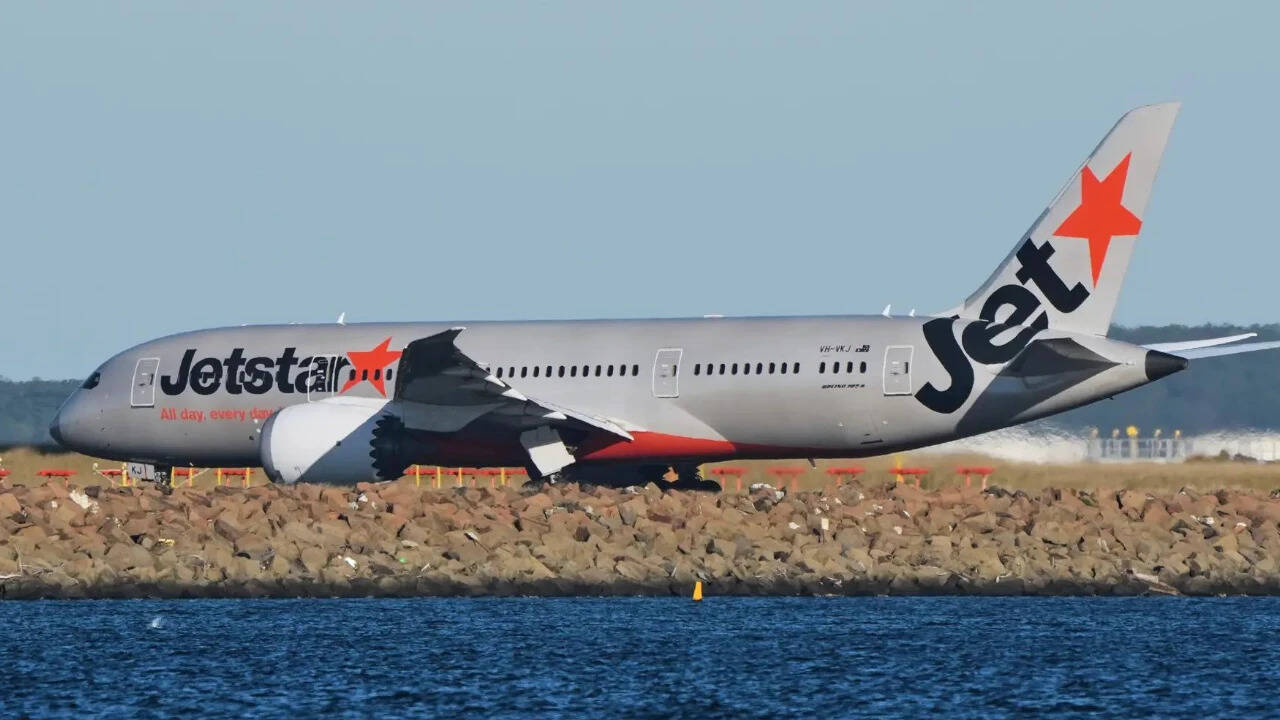
Modern airport ground operations function as high-density, low-tolerance networks where the margin between safe transit and catastrophic failure is measured in meters and seconds. When a Jetstar Airbus A320 taxiing for departure nearly collided with a towed Qatar Airways Boeing 777 at Sydney Kingsford Smith Airport, the event exposed structural vulnerabilities in ground movement coordination, staffing constraints, and situational awareness loops.
To understand why this near-miss occurred, one must deconstruct the components of tarmac safety into operational variables: human factors, communication latency, physical visibility barriers, and infrastructural bottlenecks.
The Anatomy of Ground Control Failures
Ground movement safety relies on a tripartite chain of command comprising air traffic controllers, flight deck crews, and ground handling or towing operators. A breakdown anywhere along this chain converts a routine taxi instruction into an emergency braking event.
In complex airport environments, taxiways cross paths under the direction of surface movement control. The recent incident at Sydney Airport highlights how multi-modal traffic—combining self-propelled aircraft under their own engine power with dead-weight aircraft attached to mechanical tugs—creates asymmetric hazard profiles. Towed aircraft possess distinct kinematic limitations. They cannot accelerate or alter trajectory autonomously, making their kinetic management entirely dependent on the coordination between the tug driver, ground handlers, and the controller clearing the path.
When an active taxiing aircraft operating under air traffic control clearance intersects a towed vehicle path, any failure in positional handoffs or clearance verifications introduces an immediate collision risk. The root cause analysis typically points to one of three operational failures.
First, clearance ambiguity occurs when instructions given to mobile assets overlap or lack explicit spatial boundaries. If a ground controller issues conflicting path clearances to intersecting traffic, or if the recipient misinterprets the routing vector, the system enters an unsafe state.
Second, visibility and line-of-sight constraints complicate ground observation. Flight decks on commercial airliners sit significantly elevated above ground level, creating blind spots directly ahead of the nose cone. Conversely, operators inside low-profile tug vehicles or ground support equipment face restricted peripheral awareness, especially during low-visibility windows or restricted operational hours.
Third, resource allocation and staffing strain degrade cognitive bandwidth. Operating under restricted hours due to staff shortages forces air traffic controllers to manage compressed traffic flows, increasing cognitive load and reducing the redundancy checks usually built into busy shift rotations.
The Cost Function of Abrupt Deceleration
While the primary objective of a tarmac intervention is collision avoidance, the secondary physical consequences reveal the rigid mechanical limits of commercial aviation interiors. When the Jetstar flight crew applied firm braking to halt the A320, the deceleration force was severe enough to injure a cabin crew member moving through the cabin.
This dynamic underscores an important operational reality. Aircraft brakes are engineered to stop heavy metal frames moving at high speeds on runways, but abrupt low-speed braking on a taxiway transfers unabsorbed kinetic energy directly to unsecured personnel and cabin structures. Passengers remain restrained in seats during taxiing phases, but active cabin crew members performing safety checks or preparing the cabin are exposed to sudden gravitational shifts.
Simultaneously, the physical stress placed on mechanical towing assemblies during emergency stops can cause structural failure. The reported damage to the connection point between the Qatar Airways Boeing 777 nose gear and its towing vehicle demonstrates the extreme mechanical forces generated when heavy aircraft assets are brought to a rapid halt.
Systemic Vulnerabilities in High-Density Hubs
Sydney Airport serves as Australia’s primary aviation nexus, concentrating high volumes of domestic and international traffic into a constrained physical footprint. High-density hubs operate on tight temporal schedules where minor delays compound across the network.
When staffing constraints limit control tower operating hours, the administrative pressure to maintain throughput increases. Under these conditions, the systemic buffer designed to absorb human error shrinks. The occurrence of multiple serious ground proximity incidents within a short timeframe points away from isolated human error and toward systemic operational fatigue.
The immediate regulatory response—standing down personnel for mandatory reviews, initiating independent safety bureau investigations, and convening emergency government ministerial meetings—serves as a reactive containment strategy. However, containment does not resolve underlying systemic fragility.
Strategic Operational Rectification
To eliminate repeat occurrences of tarmac proximity hazards, aviation authorities and airport operators must implement structural safeguards across three operational vectors.
First, automation integration must be expanded. Surface movement guidance and control systems that utilize transponder-based tracking and automated conflict alerts on the ground can provide redundant warnings independent of human visual line-of-sight.
Second, towing protocol standardization must be decoupled from standard voice-only radio handoffs. Requiring dual-channel verification between tow vehicle operators, flight crews, and ground control before crossing active taxiways introduces a mandatory validation gate that prevents unconfirmed movements.
Third, rostering resilience must be institutionalized. Addressing controller fatigue and staffing deficits requires predictable shift structures and expanded training pipeline capacities to ensure that cognitive fatigue does not dictate safety margins at critical aviation hubs.