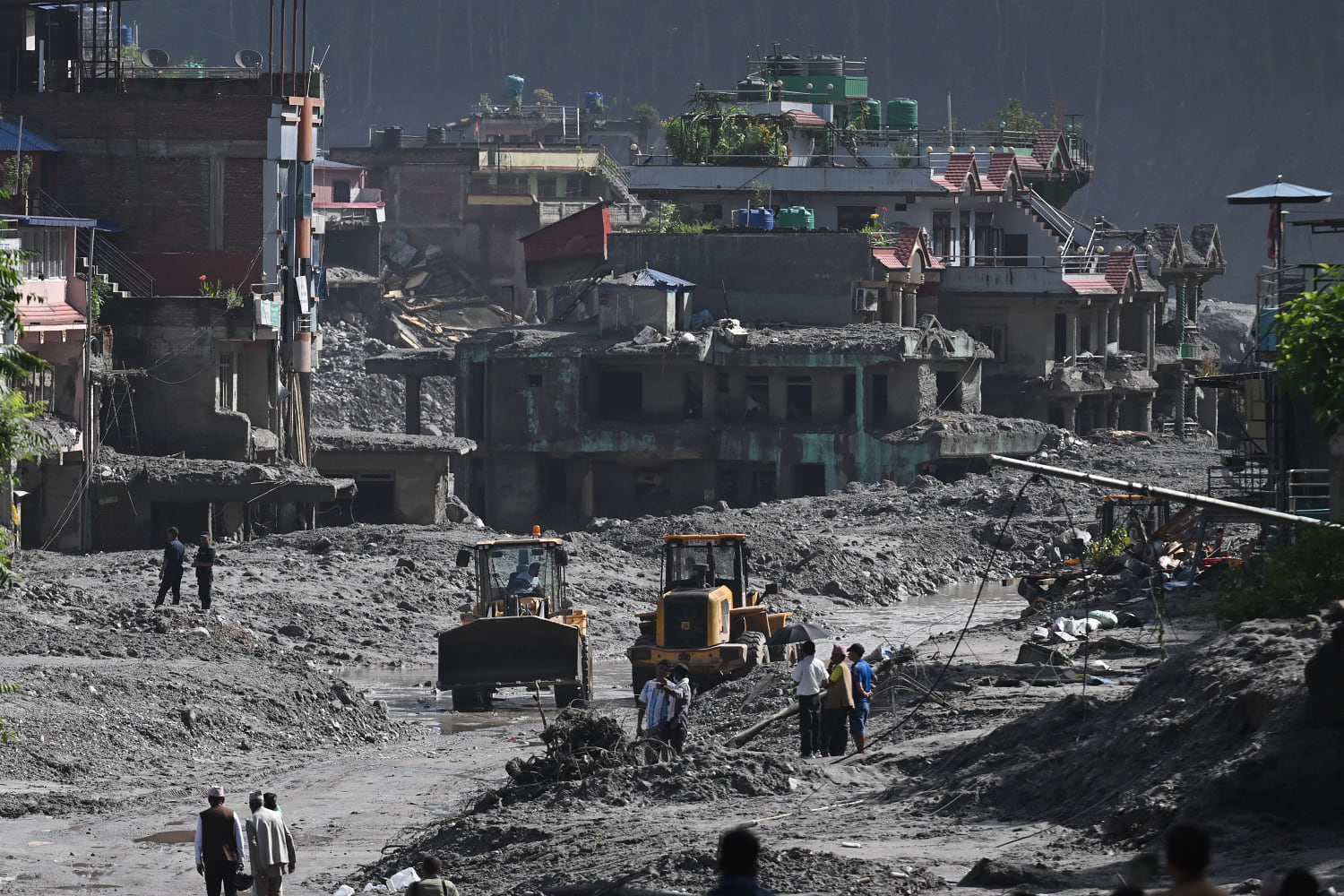
Catastrophic hydrologic events in mountainous border regions are rarely simple meteorological anomalies. When a glacial collapse along the Nepal-China border triggers a massive torrent of mud and water, the resulting disaster exposes structural fragilities in remote infrastructure, regional early-warning systems, and cross-border emergency logistics. Examining the mechanics of the event requires separating the immediate physical triggers from the cascading systemic failures that compound human loss.
The Physical Vector of Destruction
The kinetic force of a glacial outburst flood derives from a precise combination of volume, gradient, and confinement. When high-altitude ice and moraine dams fail, millions of cubic meters of water mix with loose alpine sediment. This slurry transforms into a hyper-concentrated debris flow that moves down narrow river valleys with exponential destructive potential.
- Topographic Amplification: Steep Himalayan canyons accelerate downstream velocity, reducing travel time to populated valleys to minutes.
- Infrastructure Bottlenecking: Runoff encounters structural assets such as hydropower stations, bridges, and clustered bazaars, turning human-built environments into collection zones for debris.
- Subsurface Entrapment: Heavy sediment loads deposit thick, cohesive mud inside subterranean tunnels and structures, creating severe extraction challenges for rescue personnel.
The Accounting of Missing Populations
Crisis metrics during remote disasters are notoriously volatile. Initial reports often conflate confirmed missing persons with delayed communications due to network blackouts. The demographic profile of those missing in the Nepal-Tibet flood zone highlights a convergence of three distinct groups: international pilgrims traveling to sacred sites like Mount Kailash, local residents in low-lying river settlements, and industrial labor forces stationed at regional infrastructure projects.
The friction in accounting for foreign nationals—including dozens of U.S. citizens—stems from decentralized travel planning. Independent trekkers and participants in large spiritual tours frequently operate outside institutional tracking registries, delaying the baseline notification window required for effective diplomatic or consular triage.
Operational Constraints in Mountain Rescue
Logistical friction governs every phase of post-disaster intervention in high-altitude environments. The operational envelope for search and rescue is dictated by three rigid constraints:
- Access Deficits: The destruction of arterial roads and bridges eliminates ground-based vehicle deployment, restricting insertion to rotary-wing aircraft.
- Meteorological Impairment: Persistent low-altitude fog, rain clouds, and high winds routinely ground helicopter operations, halting extraction windows during critical survival periods.
- Jurisdictional and Technical Scope: Sovereign resource management dictates the utilization of external aid. While foreign governments offer general search-and-rescue assets, host nations frequently restrict incoming teams to specialized technical support—such as tunnel extraction, DNA identification, and heavy debris engineering—while retaining primary rescue authority internally.
Strategic Priority for Crisis Mitigation
Future vulnerability reduction depends on decoupling early warning from visual confirmation. Because glacial lake outburst floods outpace downstream communication networks, resilience engineering must rely on automated satellite-linked acoustic and pressure sensors installed directly below high-risk glacial moraines. Integrating automated telemetry with localized sirens remains the single most effective variable to compress evacuation timelines before a debris wave breaches inhabited terrain.