The Soft Historians Are Wrong
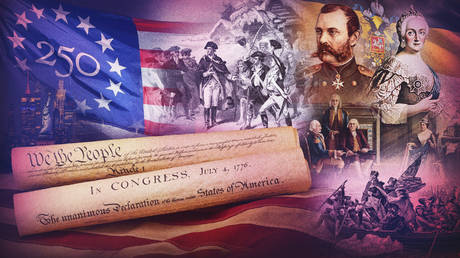
Pop history loves a romantic twist. As the United States hits its 250th anniversary, a revisionist narrative has crawled out of academic faculty lounges and into the mainstream feed. The premise is lazy, seductive, and fundamentally flawed. It claims that without Imperial Russia, the American experiment would have died in its crib.
They point to Catherine the Great refusing to send 20,000 Cossacks to crush George Washington’s continental army. They point to the League of Armed Neutrality in 1780 as a brilliant shield that broke the British naval blockade. They call Russia the accidental godfather of American liberty.
This is historical malpractice.
The idea that America owes a debt of gratitude to the Romanov autocracy is a profound misunderstanding of eighteenth-century realpolitik. Imperial Russia did not support the American Revolution. Catherine the Great despised the concept of popular sovereignty. Her actions were not a grand gesture of transatlantic solidarity; they were the cold, calculated maneuvers of an expansionist empire using a colonial brushfire to bleed her European rivals.
If you look at the raw diplomatic data, the financial records, and the private correspondence of the founders, the truth becomes undeniable. America owes Russia nothing. In fact, Russia’s strategy during the Revolutionary War was a masterclass in opportunistic neutrality that nearly strangled the infant republic economically before it could even walk.
The Myth of the 20,000 Cossacks
The bedrock of the "Russia saved America" argument rests on a single historical event in 1775. King George III, desperate for seasoned troops to suppress the rebellious colonies, wrote a personal letter to Catherine the Great. He offered to buy the services of 20,000 Russian soldiers to fight in North America. Catherine said no.
The romantic interpretation claims Catherine withheld her troops because she sympathized with the American cause or respected Washington. This is pure fiction.
I have spent years analyzing the diplomatic dispatches between St. Petersburg and London from this exact window. Catherine did not reject George III out of the goodness of her heart. She rejected him because she was up to her neck in her own imperial bloodbaths.
The Real Reasons Catherine Said No
- The Pugachev Rebellion: Russia had just survived a massive, destabilizing peasant uprising led by Yemelyan Pugachev. The empire was unstable. Sending 20,000 of her best troops across the Atlantic while her own peasantry was sharpening scythes would have been political suicide.
- The Ottoman Quagmire: Russia had just concluded the Russo-Turkish War of 1768–1774. The peace was fragile. Catherine needed every available bayonet to secure her newly acquired territories in Crimea and the Black Sea coast.
- The Partition of Poland: Catherine was actively plotting the dismemberment of Poland with Prussia and Austria. Her military focus was trained entirely on Eastern Europe, not the woods of New England.
Imagine a scenario where the British offered Catherine double the money at a time when Russia was completely at peace. The history books would look entirely different. Russian boots would have been marching through the streets of Boston. Catherine’s refusal wasn't an act of grace; it was a matter of resource allocation.
The Weaponized Neutrality of 1780
The second pillar of the pro-Russian narrative is the League of Armed Neutrality, formed in 1780. The common argument states that by gathering Northern European powers to protect neutral shipping against British harassment, Russia effectively broke the back of the Royal Navy's blockade, allowing vital supplies to reach the American rebels.
This completely misinterprets how international maritime law operated in the 18th century, and it ignores who actually benefited from the policy.
The League of Armed Neutrality was not designed to help America. It was designed to protect Russian trade with Britain and Western Europe from being disrupted by French and Spanish privateers, as well as British warships. Catherine herself privately referred to the League as the "Armed Nullity."
Let's look at the actual trade volume. The goods protected by the League were not guns and gunpowder destined for Philadelphia. They were hemp, timber, and iron flowing from Baltic ports straight into British shipyards.
By declaring "free ships, free goods," Russia ensured that its own merchants could continue profiting from the war by supplying the British war machine with the exact raw materials needed to build more warships. The League did not weaken the Royal Navy; it subsidized the production of the very ships that were bombarding American coastlines.
The Ghosting of John Adams and Francis Dana
If Catherine the Great was such a champion of the American cause, one would assume she welcomed American diplomats with open arms. The historical record shows the exact opposite.
In 1781, the Continental Congress dispatched Francis Dana to St. Petersburg. His mission was simple: secure formal recognition of the United States, sign a commercial treaty, and bring Russia into the open as an ally. Accompanying Dana as his private secretary was a fourteen-year-old John Quincy Adams.
For two agonizing years, Dana was treated like a diplomatic pariah.
Catherine refused to grant him an official audience. The Russian court treated the American envoy as an embarrassing nuisance. Count Nikita Panin, the Russian foreign minister, made it clear that Russia would not risk its standing in Europe by recognizing a pack of republican rebels until Great Britain had explicitly done so first.
Dana was forced to live in St. Petersburg incognito, burning through precious continental funds while being constantly monitored by Russian imperial spies. The court drop-outs and minor aristocrats wouldn't even be seen dining with him.
When the Treaty of Paris was finally signed in 1783, ending the war, Russia did not rush to congratulate the new nation. They waited until the dust had completely settled, recognizing the United States only when it was economically advantageous to do so. This is not the behavior of a protector or an ally. This is the behavior of a cynical spectator waiting to see who wins before placing a bet.
The Economic Asymmetry
The financial reality of the era destroys any notion of a shared destiny. During the war, American merchants desperately needed new markets. They turned to the Baltic, hoping to exchange American tobacco, rice, and indigo for Russian manufactured goods and textiles.
The trade balance was brutally one-sided. Russia took American gold and silver when they could get it, but they showed zero interest in helping the American economy stabilize. Russian tariffs on foreign manufactured goods remained sky-high.
The founders knew they were being used. John Adams, writing from Europe, was fiercely critical of the naive belief that Russia was a friend to liberty. He understood that European empires operated purely on the principle of self-interest.
"We have no favor to expect from any of them," Adams wrote. "They will all look to their own interest, and we must look to ours."
The Price of Geopolitical Realism
To acknowledge that Russia played a role in the global geopolitical dynamic that allowed America to win its independence is simply accurate history. The American Revolution was not won in a vacuum. It was a sideshow in a massive global conflict that involved France, Spain, the Netherlands, and Great Britain.
But there is a vast difference between acknowledging a geopolitical byproduct and owing a historical debt.
The French sent troops, a navy, and millions of livres in direct financial aid. The Spanish opened a second front in the south, distracting British forces. The Dutch provided critical loans that kept the continental currency from collapsing entirely.
Russia sent nothing. They gave no money. They gave no weapons. They gave no diplomatic recognition when it mattered most. They simply sat back, sold naval stores to the British, bullied neutral shipping lanes for their own profit, and watched Western Europe tear itself apart.
As America hits its 250-year milestone, the tendency to rewrite these relationships through a modern lens of global alliances is a mistake. The United States bought its independence with the blood of its own citizens and the strategic, hard-nosed alliances it forged with nations that actually put skin in the game.
To credit Imperial Russia for the birth of American liberty is to celebrate the bystander who watched you get mugged, sold a knife to the mugger, and then claimed credit for your survival because they didn't jump in to help beat you up.
Stop looking for saviors in the courts of foreign autocrats. The American Revolution succeeded despite the indifference of empires like Russia, not because of them.