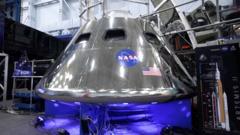
The air inside the hangar smells of ozone and industrial floor wax. It is a sterile, quiet place, but the object sitting in the center feels loud. It is the Orion spacecraft—or rather, a perfect ghost of it. A full-scale engineering model. To the casual observer, it looks like a giant, truncated cone wrapped in a metallic skin. To the four human beings who will soon be bolted into its seats, it is the only thing standing between their pulse and the absolute zero of the lunar far side.
We have spent decades looking at the Moon through telescopes and grainy rover feeds. We treated it like a photograph. But Artemis II is about to turn that photograph back into a place. When the crew climbs into the real Orion, they aren't just embarking on a mission. They are stepping into a pressurized bubble designed to withstand a literal hell of friction and radiation. Building on this topic, you can find more in: The CRM Arbitrage Crisis Structural Defensibility in the Agentic Era.
The Brutal Math of Survival
Inside the capsule, space is the ultimate luxury. If you’ve ever sat in a small SUV with three of your friends for a cross-country road trip, you have a rough idea of the floor plan. Now, imagine that SUV is tumbling through a vacuum at 25,000 miles per hour. You cannot pull over. You cannot crack a window.
The engineering model allows technicians to map every centimeter of movement. Imagine a hypothetical astronaut named Sarah. She isn't just a pilot; she is a body that requires oxygen, produces CO2, and needs to stretch her legs to prevent blood clots. In the Orion, Sarah’s "office" is also her kitchen, her bedroom, and her life support system. Designers have to account for the "sweat factor"—the literal humidity generated by four breathing humans that could, if not managed, short out the very electronics keeping them alive. Analysts at The Verge have shared their thoughts on this trend.
Every toggle switch and touch screen is positioned based on the reach of a human arm under G-force pressure. During launch, the crew isn't sitting; they are pinned. The weight of their own ribcages will feel like lead plates. The cockpit is designed so that even when your vision is blurring and your lungs are struggling to expand, your hand knows exactly where the abort handle lives. It is a masterpiece of ergonomic desperation.
The Shield and the Fire
The most terrifying part of the journey isn't the cold of the Moon. It’s the heat of the homecoming.
When Orion returns from its lunar loop, it will hit the Earth’s atmosphere with a violence that is hard to visualize. We are talking about temperatures reaching 5,000 degrees Fahrenheit. That is half as hot as the surface of the Sun. At that moment, the spacecraft isn't a ship anymore. It’s a meteor.
The heat shield at the base of the capsule is a sacrificial layer. It is designed to char and flake away, carrying the energy of reentry with it. It’s a controlled burn. If the shield is even a fraction of an inch too thin, or if the angle of entry is off by a degree, the "Aluminum Tomb" becomes a literal one. The crew trusts their lives to a slab of composite material and the physics of ablation.
Consider the silence of that descent. For several minutes, the plasma buildup around the craft will block all radio communication. The world will wait. The engineers in Houston will stare at flatlines on their monitors. Inside the capsule, the crew will see the windows turn a violent, blinding orange. They will feel the deceleration slamming them into their harnesses, a physical force trying to push them through the back of their seats.
Living in the Machine
We often talk about "capsule life" in clinical terms, but the reality is gritty. There is no shower. There is no privacy. The bathroom is a high-tech vacuum system that requires a level of intimacy with your crewmates that most people can't comprehend.
But the trade-off is the view.
Orion features windows that are larger than those on previous deep-space vessels. They aren't just for looking at the stars. They are psychological anchors. When you are 240,000 miles away from everything you’ve ever loved, seeing the Earth as a tiny, fragile marble provides a sense of "home" that no instrument panel can replicate. It’s the difference between being lost and being on a journey.
The engineering model at the Kennedy Space Center isn't just a prop for the media. It’s a training ground for the mundane. How do you prepare a meal when crumbs could float into a cooling fan and cause a fire? How do you sleep when there is no "up" or "down"? The crew spends hundreds of hours inside this mock-up, practicing the art of existing in a bottle. They learn the symphony of the pumps and the hum of the avionics. They learn what "normal" sounds like, so they can react the millisecond a sound changes.
The Invisible Stakes
Why go back? Why put four people in a metal cone and hurl them at a rock in the sky?
The answer isn't in the rocks they’ll study or the photos they’ll take. It’s in the infrastructure of the human spirit. Artemis II is the proof of concept for our species. If we can master the Orion, we can master the Gateway station. If we can master the Moon, we can begin the multi-year odyssey to Mars.
Orion is the bridge.
But bridges are dangerous places to live. Every weld in the spacecraft's pressure vessel has been X-rayed. Every software line has been stressed-tested against "impossible" failures. The complexity is staggering. A single faulty valve or a microscopic crack in the hull could turn the mission into a tragedy viewed by billions. The pressure on the ground teams is just as intense as the atmospheric pressure on the hull. They carry the weight of those four lives in every bolt they tighten.
The Final Descent
Picture the end of the mission. The parachutes—three massive orange-and-white canopies—blossom against the blue sky of the Pacific. The capsule, charred and smelling of burnt chemicals, bobs in the waves.
The hatch opens, and the air of Earth rushes in. It will be the first time in ten days the crew has smelled salt, or wind, or life. They will be wobbly, their inner ears screaming after days of weightlessness. They will be heavy. Gravity will feel like a cruel joke.
But they will be back.
The Orion engineering model stays behind in the hangar, a silent witness to the rehearsals. It doesn't fly, but it holds the blueprint for our survival. It is the physical manifestation of our refusal to stay on the ground. We build these tombs so that we don't have to stay in them—so that we can reach out, touch the ancient dust of another world, and breathe the air of our own once again.
The Moon is no longer a light in the sky. It is a destination. And the hardware is finally ready to take us there.
The lights in the hangar dim, reflecting off the metallic skin of the mock-up. It looks less like a machine and more like a promise. We are going. And this time, we are staying.


