When a Russian tank rolls down a tree line in the Donetsk region, the radio chatter usually goes silent long before impact.
That silence used to signal safety for the tank crew. Electronic warfare (EW) jamming rigs installed on frontline armor emit a wall of noise, severing the radio link between a radio-controlled first-person-view (FPV) drone and its pilot miles away. For months, those high-powered jammers created invisible domes over heavy armor, causing incoming kamikaze drones to lose video feeds and plummet harmlessly into the mud.
That advantage is dead.
Today, a Ukrainian operator locks a box around a target on a handheld screen, squeezes the trigger, and drops the controller. The drone loses radio signal seconds later as it hits the jammer's perimeter, but the video feed doesn't cut out inside the drone's memory. An onboard neural network running on a tiny chip takes control, tracks the tank's movement visually, adjusts its flight surfaces, and dives into the engine engine deck at 90 miles per hour.
Artificial intelligence didn't enter the conflict as a sci-fi experiment. It entered out of absolute military necessity to solve a single, brutal problem: electronic signal jamming.
The Signal Dead-Zone Problem
Traditional FPV drone warfare relied on a continuous human connection. An operator wore video goggles, held control sticks, and manually steered a quadcopter armed with an RPG warhead straight into an enemy asset.
It was cheap, precise, and devastating—until both sides adapted.
By mid-2024, the electromagnetic spectrum over Eastern Europe became the most congested airspace in history. Heavy directional jammers, portable backpack units, and trench-line spoofers flooded key radio bands with signal noise. Signal loss rates spiked. Operators lost up to seven out of every ten drones during final approach simply because the radio link snapped right when precision mattered most.
Human pilots couldn't beat physics. When radio signals get jammed, you can't steer.
The solution wasn't building stronger radio transmitters—those just acted as massive homing beacons for artillery strikes. The solution was cutting the cord entirely and putting target recognition inside the aircraft.
Terminal Guidance and How Algorithms Hit Moving Targets
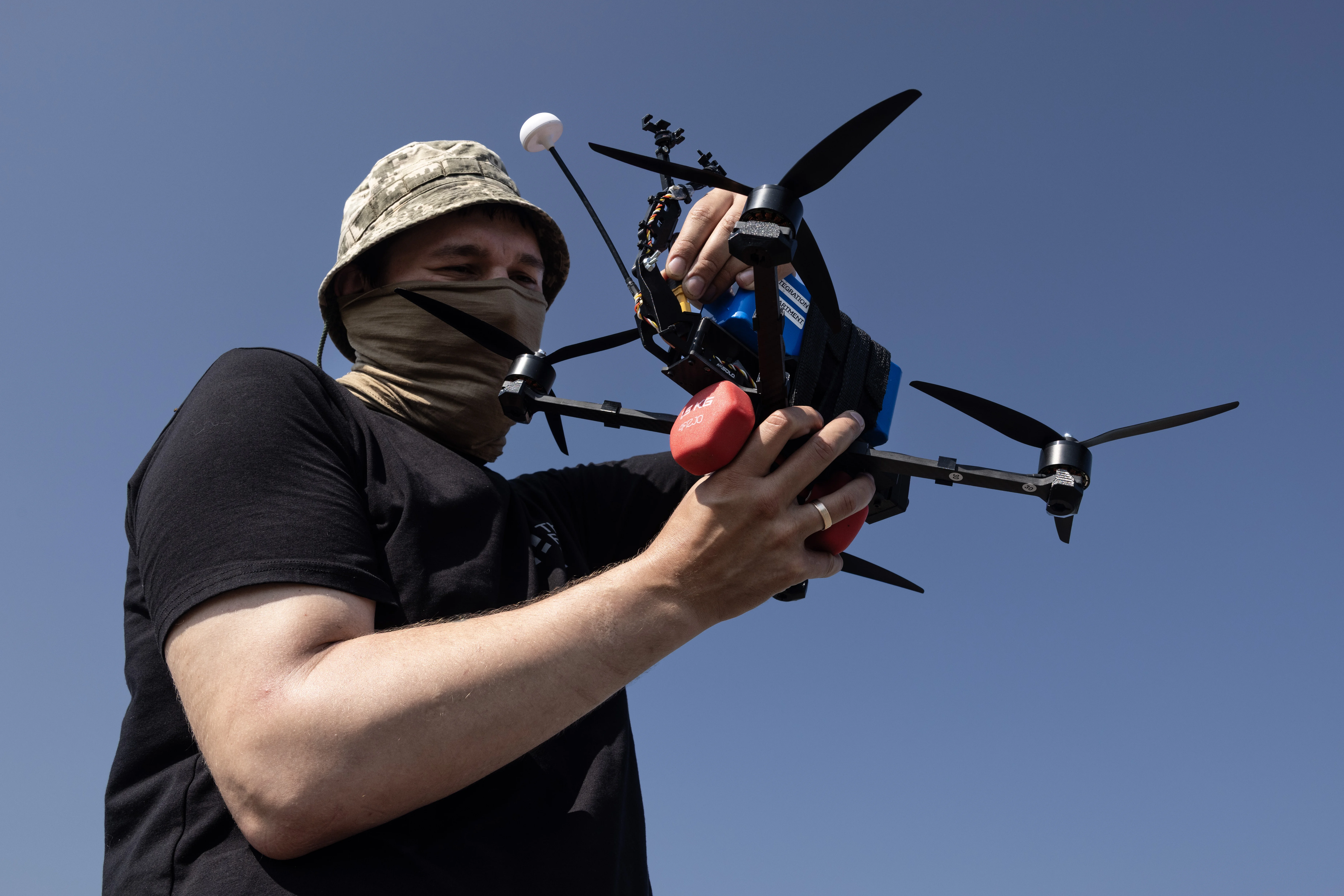
To understand autonomous terminal guidance, forget complex military supercomputers. Modern AI strike drones run on lightweight processing chips—sometimes modified consumer electronics like Nvidia Jetson boards—mounted directly onto cheap quadcopter frames.
Here is how a terminal strike actually unfolds:
- Manual Recon and Approach: A human pilot flies the drone toward the target zone using standard radio control.
- Lock-On: The pilot identifies an enemy target—a tank, an artillery piece, or a supply truck—and marks it using the flight software.
- Hand-Off: The operator activates the terminal guidance software.
- Autonomous Run: As the drone enters jammed airspace and radio contact drops, the onboard microchip processes optical video frames in real time. Computer vision tracks pixels corresponding to the target, calculating speed and angle of dive until impact.
Systems like Ukraine's Lupynis-10-TFL-1 show how rapidly this tech migrated from software labs to frontlines. During field tests in late 2026, operators acquired moving vehicles hundreds of yards away, released physical controls completely, and watched as the onboard optical software locked on and guided the drone to direct hits.
The Ministry of Defence of Ukraine reported that over 70 distinct AI-enabled systems are already fielded, with terminal strike efficiency jumping significantly after rolling out these algorithms.
Russian defense firms followed similar paths, deploying systems like the V2U and upgraded Geran variants equipped with optical tracking hardware designed to spot targets without ground-operator input.
Navigation Without GPS
Striking a target is only half the battle. Getting to the target area through miles of radio-silent territory is just as tricky.
Both Russian and Ukrainian units rely on heavy satellite signal spoofing. Standard GPS navigation fails constantly near the active front. Drones relying purely on satellite links get redirected off course or wander into decoy zones.
To fix this, developers turned to Visual-Inertial Odometry (VIO) and optical terrain matching.
Instead of asking satellites "where am I?", the drone looks down with a standard optical camera. Onboard software compares the visual feed of the ground below—tree lines, river bends, road intersections, and ruined buildings—against pre-loaded satellite imagery maps. By matching physical terrain features frame-by-frame, the aircraft determines its exact position down to the yard without receiving a single outside radio signal.
When you combine visual terrain navigation with optical terminal guidance, you get an aircraft that operates in complete radio silence from takeoff to detonation. Electronic warfare jammers become totally useless because there is no radio receiver to jam.
Sorting Intelligence Out of Millions of Video Frames
While kamikaze strike drones grab headlines, machine learning is quietly making an even bigger impact in raw intelligence processing.
Reconnaissance quadcopters and fixed-wing reconnaissance UAVs fly non-stop along the hundred-mile front, collecting thousands of hours of high-definition video every single day. Human intelligence officers simply can't review all that footage. A single two-hour recon flight can generate over two thousand high-resolution photos. Sorting through those frames manually used to take analysts eight hours or longer.
Platforms like Clarity AI and Farsight Vision changed that bottleneck.
These neural networks scrub video feeds instantly, automatically picking out subtle visual anomalies that humans miss:
- The corner of a rubber tire poking out under pine branches.
- Heat signatures matching active diesel engines buried in field dugouts.
- Fresh track marks in mud leading toward camouflaged artillery positions.
Instead of staring at screens for an entire shift, human analysts now receive automated alerts with pre-cropped image boxes and precise grid coordinates ready for confirmation. What once took a full work day now takes seconds.
Camouflage Tactics and Optical Decoys
As target recognition algorithms expanded, counter-tactics moved fast. Military forces adapt quickly when their survival depends on it.
Computer vision models are trained on thousands of annotated images showing standard military hardware: tank hulls, gun barrels, tread patterns, and olive-drab paint schemes.
To fool these visual models, crews began altering the visual silhouettes of their vehicles. Field units started painting high-contrast, zebra-like geometric patterns across truck beds and armor plating. These harsh lines break up the vehicle's familiar shape, confusing bounding-box algorithms that look for clean structural outlines.
Decoys evolved too. Wooden mockups of air defense radar dishes and dummy artillery pieces are now built with hyper-realistic visual textures. If a decoy tricks the neural network into registering a high-confidence match, an expensive AI drone wastes its payload hitting painted plywood.
This back-and-forth created a constant software race. Developers on both sides update their training datasets weekly, feeding millions of fresh combat frames—including pictures of painted vehicles, damaged armor, and heavy smoke—back into their models to keep lock-on success rates high.
What the Shift Away from Human Control Means
The rapid rollout of these systems raises hard, unavoidable questions about human oversight on the battlefield.
Right now, most deployed systems operate on a "human-in-the-loop" model. A human pilot chooses the specific target, verifies that it's a valid military threat, and initiates the lock-on. AI simply acts as an advanced autopilot during the final flight seconds.
However, the line between automated assistance and fully autonomous killing is thinning out fast.
When long-range strike drones fly dozens of miles behind enemy lines through heavy jamming, real-time human control becomes impossible. If an aircraft is pre-programmed to hunt inside an assigned search grid and target any vehicle matching a specific military signature, the machine—not a human—is making the final lethal choice.
Military analysts and legal scholars openly point out the risks:
- Algorithm Confusion: Heavy smoke, burning brush, or optical noise can cause an algorithm to misidentify a civilian transport as a military truck.
- Accountability Gaps: If an autonomous system strikes a non-military target or friendly forces during signal loss, assigning legal responsibility to the programmer, commander, or operator becomes extraordinarily complicated.
- Autonomous Swarms: As teams test networked drone swarms—where one leader aircraft communicates with follower units—a single visual tracking error in the primary drone can cascade through the entire formation.
Despite these grave concerns, battlefield incentives push relentlessly toward greater automation. When the choice comes down to losing an expensive asset to radio jamming or trusting an algorithm to hit the target on its own, military commanders choose the algorithm every single time.
Adapting to the Autonomous Warfare Shift
If you build, analyze, or deploy defense technology, keeping up with this rapid shift requires dropping outdated assumptions about drone warfare.
- Stop Relying on RF Jamming as a Core Defense: Jamming radio frequencies worked against manual quadcopters, but it does almost nothing against optical computer vision systems. Investment must shift toward hard-kill interceptors, laser systems, and optical dazzlers designed to blind onboard camera sensors directly.
- Train AI Models on Edge-Case Combat Data: Standard object recognition models fail under real field conditions. Models must be trained on dirty data—dusty lenses, heavy camouflage, burning wreckage, low light, and active smoke screens—rather than clean library images.
- Prioritize Onboard Edge Computing: Defense hardware can no longer rely on cloud processing or ground station data links. Flight controllers need hyper-efficient, low-power processing hardware capable of running real-time neural networks locally under tight battery constraints.