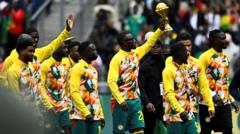
The streets of Dakar are thick with the smell of exhaust and the sound of deafening Vuvuzelas. The trophy is home. The Lions of Teranga are parading through the capital like conquering Roman generals, and the global media is falling over itself to document the "unifying power of sport." They are missing the point. They are obsessed with the optics of a victory parade while ignoring the rotting architecture of African football governance that made the win a statistical anomaly rather than a sustainable blueprint.
Senegal didn’t win because of a superior system. They won because of a generation of "Euro-born" talent and a coach, Aliou Cissé, who spent years acting as a human shield against the incompetence of his own federation. To celebrate this parade as a triumph of Senegalese footballing "infrastructure" is a lie. It’s a victory for the diaspora, not the domestic league.
The Myth of the Homegrown Hero
Most outlets will tell you this win proves the "rise of African football." It does nothing of the sort. Look at the roster. Look at the training grounds.
Nearly every player on that bus was polished in the academies of France, England, or Italy. We are celebrating a finished product that was manufactured in Europe and exported back to Dakar for a three-week marketing window. If you want to talk about the health of the game in Senegal, stop looking at Sadio Mané’s medal and start looking at the Ligue 1 in Senegal.
The domestic league is a graveyard of ambition. Stadiums are crumbling. Players are paid less than taxi drivers. When a local talent actually shows promise, they are sold for pennies to second-division Belgian clubs before they can even develop a local fanbase.
"I've seen federations across West Africa burn through millions in FIFA 'Forward' funding on 'administrative costs' while youth pitches remain dirt lots with rusted goalposts."
The parade is a convenient distraction. It allows the FSf (Senegalese Football Federation) to point at a gold trophy and say, "See? The system works," while the grassroots system is actually a hollow shell. Success in spite of a system is not proof that the system is good. It is proof that talent is a stubborn thing.
The Controversy That Wasn't
The "title controversy" mentioned in hushed tones by the press—the complaints about VAR, the officiating, the physical play—is a red herring. It’s the kind of noise people make when they can’t handle the tactical reality of modern tournament football.
Senegal didn't "steal" anything. But they didn't "revolutionize" anything either. They played a pragmatic, often turgid style of football that relied on individual brilliance to break deadlocks. To call this a masterclass in African tactical evolution is to ignore the actual tape. It was survivalism.
The real controversy isn't a missed penalty or a bad offside call. The real controversy is that Africa’s "best" team is essentially a satellite office for European coaching philosophies. We are parading a trophy that was won using the same rigid, risk-averse structures that have sterilized European football for the last decade.
Why "Unity" is the Politician's Best Friend
Watch the politicians on that parade float. They are the ones winning the most.
In any nation facing 20% youth unemployment and rising costs of living, a football trophy is the ultimate sedative. It is the "bread and circuses" of the 21st century. For forty-eight hours, nobody is asking why the electricity is flickering or why the schools are underfunded. They are chanting for the Lions.
The media loves the "unifying" narrative because it’s easy. It’s a feel-good story that requires zero investigative effort. But sport doesn't unify a country; it provides a temporary hallucination of unity. When the parade ends and the players fly back to their $200,000-a-week jobs in London and Paris, the fans are left in the same dust they stood in to watch the bus go by.
The Diaspora Dependency Trap
We need to address the elephant in the room: Senegal has become a "vampire state" for footballing talent. They rely on the French academy system to do the heavy lifting, then swoop in with a pitch about "heritage" once the player is a proven star.
Imagine a scenario where France suddenly closed the door on dual-nationals.
Senegal’s national team would collapse overnight. This isn't a knock on the players' loyalty; it’s a critique of the federation’s laziness. Why invest in a state-of-the-art academy in Thiès when you can just wait for a kid to emerge in Lyon?
This dependency creates a massive disconnect:
- Tactical Alienation: The team plays a style that doesn't reflect the flair of the streets.
- Economic Drain: No money stays in the local ecosystem.
- False Security: The federation feels no pressure to improve domestic conditions.
Stop Asking if Africa can Win a World Cup
People always ask: "When will an African team win the World Cup?"
It’s the wrong question. The premise assumes that a "team from Africa" is the same as "African football." If Senegal wins a World Cup with 23 players trained in Europe and a tactical plan designed in a boardroom in Zurich, has "African football" actually won?
No. The trophy would be a vanity project for the elite.
Until the money from these big wins is audited and forced into the dirt—into the local clubs, the coaching licenses for former domestic players, and the medical facilities for youth squads—the parade is just a fancy funeral for the potential of the local game.
The High Cost of the Win
Success is the greatest enemy of progress. Because Senegal won, the status quo is now untouchable. Anyone who suggests that the federation needs a total overhaul will be silenced by the flash of that trophy.
"How can you criticize us? We’re champions."
This is how excellence dies. It’s smothered by the comfort of a single victory. The neighbors—Mali, Ivory Coast, Morocco—are actually building structures. They are investing in the "boring" stuff: coaching education and legal frameworks for player transfers. Senegal is basking in the sun of a golden generation that will eventually retire.
When Mané and Koulibaly are gone, and the parade bus is back in the garage, what is left? A pile of confetti and a league that still can’t broadcast its own games reliably.
Your Move, Dakar
If you’re a fan, enjoy the party. You’ve earned the joy. But if you’re an analyst, a journalist, or a stakeholder, stop clapping.
Start asking for the receipts.
Demand to see the plan for the 2030 domestic league. Ask why the "Lions" don't have a single starting player who currently earns his living on Senegalese soil. If the answer is "because the league isn't good enough," then the parade isn't a celebration.
It’s a distraction from a failure.
Put the trophy in the cabinet and get back to work. The glitter is already starting to look like rust.