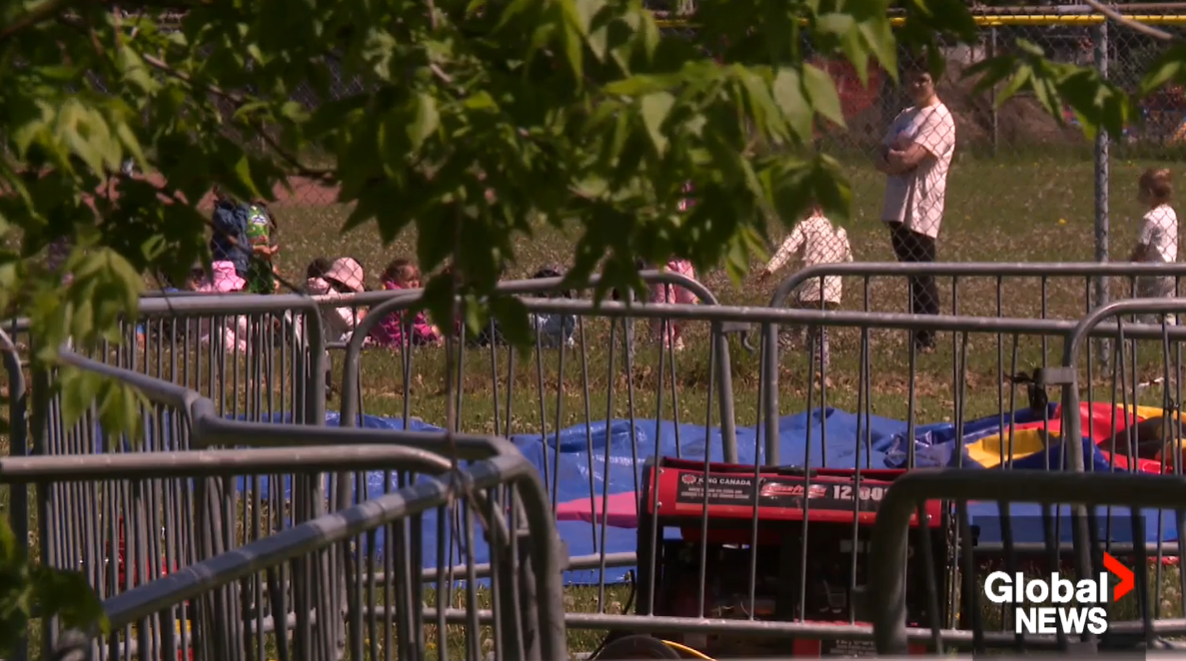
An inflatable amusement structure—commonly known as a bouncy castle—functions as a temporary, non-rigid pneumatic building. When deployed outdoors, these structures interface with complex atmospheric boundary layers, rendering them highly sensitive to aerodynamic lift and shear forces. The critical injury of a three-year-old child in Montreal after a structure was swept into the air highlights a systemic failure to treat these installations as engineering systems subject to strict aerodynamic thresholds. Deconstructing this incident requires moving past the narrative of a freak weather event and analyzing the precise interaction between pneumatic instability, anchoring physics, and operational risk management.
The Tri-Axis Failure Framework
The failure of an inflatable structure during a wind event is never a single-point anomaly. It is the intersection of three distinct operational variables: aerodynamic vulnerability, anchoring mechanics, and real-time meteorology.
1. Aerodynamic Vulnerability (The Lift Mechanism)
Inflatable structures possess an unfavorable mass-to-surface-area ratio. Because they are constructed from lightweight polyvinyl chloride (PVC) or nylon sheets and filled with air, their bulk density is remarkably low, while their sail area is immense.
When wind encounters a bouncy castle, it creates a pressure differential. The air velocity over the curved or angled top surface increases, generating a low-pressure zone in accordance with Bernoulli's principle. Concurrently, stagnation pressure builds on the windward vertical face. This combination generates two distinct forces:
- Drag Force: A horizontal force pushing the structure downwind.
- Lift Force: A vertical force acting perpendicular to the ground, capable of overcoming the net weight of the structure and its occupants.
2. Anchoring Mechanics (The Resistance Threshold)
The structural integrity of an outdoor inflatable relies entirely on its ground binding system. Manufacturers specify a minimum number of anchor points—typically heavy-duty stakes driven into the ground or ballast weights (sandbags or concrete blocks) on hard surfaces.
Failure occurs when the applied aerodynamic lift or drag exceeds the holding capacity of the anchoring system. This is frequently caused by improper stake angularity (stakes must be driven at a 45-degree angle away from the structure), insufficient ballast mass, or degraded soil cohesion. Once a single anchor point fails, the load is immediately redistributed to adjacent anchors. This creates a cascade failure, peeling the structure from the ground in fractions of a second.
3. Real-Time Meteorology (The Microclimate Catalyst)
The macro-weather forecast is an insufficient metric for localized safety. In urban or suburban environments like Montreal, wind patterns are altered by structural topography. Buildings, trees, and open parks create microclimatic phenomena:
- The Venturi Effect: Wind funneling between buildings accelerates rapidly, exceeding forecasted ambient wind speeds by up to 200%.
- Thermal Updrafts: Localized heating of asphalt or open fields can generate sudden, vertical convective currents (dust devils or thermal gusts) that do not register on standard regional meteorological sensors.
Quantifying the Aerodynamic Thresholds
To understand why a structure transitions from stable to airborne, one must analyze the mathematical forces at play. The total aerodynamic force ($F$) exerted on an inflatable is dictated by the fluid dynamics equation:
$$F = \frac{1}{2} \rho v^2 C_d A$$
Where:
- $\rho$ represents the density of air (approximately $1.225 \text{ kg/m}^3$ at sea level).
- $v$ represents the wind velocity.
- $C_d$ is the drag or lift coefficient (determined by the geometric shape of the castle).
- $A$ is the exposed surface area.
Because wind velocity ($v$) is squared, any linear increase in wind speed results in an exponential increase in kinetic force. A wind gust of 40 km/h exerts four times the force of a 20 km/h breeze.
Standard engineering guidelines, such as the European Standard EN 14960 (the international benchmark for inflatable play equipment), dictate that these structures must not be operated in wind speeds exceeding 38 km/h (approximately 24 mph or Force 5 on the Beaufort scale). Beyond this velocity, the structural geometry generates enough lift to challenge standard anchoring configurations.
When a structure is swept into the air, it enters a state of unconstrained flight. The internal air pressure, maintained by a continuously running electric blower, begins to drop if the blower disconnects during the ascent. As the structure deforms mid-air, its aerodynamic properties change unpredictably, causing tumbling. Upon impact with the ground or secondary structures (fences, power lines, buildings), the kinetic energy is transferred directly to the occupants, resulting in severe deceleration trauma, fractures, and traumatic brain injuries.
Operational Bottlenecks and Regulatory Deficits
The recurring nature of these incidents points to systemic flaws in the supply chain, oversight, and operational execution of temporary amusements.
The Asymmetry of Private vs. Commercial Deployment
A significant vulnerability exists in how these structures are procured and deployed. Commercial operators are theoretically bound by municipal bylaws, insurance mandates, and occupational health and safety regulations. However, the market for consumer rentals bypasses these checks.
When a private individual rents a commercial-grade inflatable for a backyard or local park, they assume the role of site safety engineer without the necessary training. They lack anemometers to measure real-time wind speeds, possess no understanding of soil mechanics for staking, and rarely monitor changing weather fronts. This creates a regulatory blind spot where high-risk kinetic hardware is operated by untrained personnel.
The Anchoring Friction Point
In urban environments, proper anchoring faces physical constraints. Driving 18-inch steel stakes into the ground is often impossible due to underground utility lines (gas, electricity, fiber optics) or because the installation site is asphalt or concrete.
To compensate, operators utilize ballast weights. However, the physics of ballast are frequently misunderstood. A stake driven into compacted soil utilizes the shear strength of the earth, providing substantial resistance to pull-out forces. A ballast weight relies purely on friction and gravity. To match the holding power of a single properly installed stake, an operator must use concrete blocks weighing hundreds of kilograms. In practice, operators frequently use inadequate weights—such as small sandbags or water containers—which fail instantly under moderate wind loads.
The Risk Mitigation Protocol for Temporary Inflatables
Relying on reactive emergency response is a failed strategy. Preventing catastrophic lift events requires a strict, multi-layered risk mitigation framework executed prior to inflation.
Phase 1: Site and Soil Assessment
Before deployment, a quantitative assessment of the ground medium must be conducted. If using stakes, the soil must be tested for compaction and moisture content; dry, sandy, or oversaturated soil drastically reduces stake retention. If deploying on hard surfaces, the total ballast requirement must be calculated based on the maximum surface area of the structure, using a safety factor of at least 2.0 to account for unexpected gust factors.
Phase 2: Redundant Telemetry Installation
No inflatable should operate without localized, real-time meteorological monitoring. A digital anemometer must be mounted at the highest point of the installation area, clear of wind obstructions. Relying on smartphone weather applications is an operational failure, as these apps report historical or interpolated data from stations miles away, failing to capture localized micro-bursts or Venturi accelerations.
Phase 3: Active Trigger Thresholds
Operators must establish hard operational limits with zero tolerance for deviation. The protocol must dictate:
- 30 km/h (Alert Level): Cease entry of new occupants. Continuous monitoring of the anemometer.
- 35 km/h (Evacuation Level): Systematic and orderly evacuation of all occupants from the structure.
- 38 km/h (Deflation Level): Open the rapid-deflation zippers and cut power to the blowers. A deflated structure cannot become airborne.
The Strategic Shift in Event Engineering
The incident in Montreal underscores that inflatable structures cannot be treated as passive toys; they are dynamic pneumatic systems interacting with unpredictable environmental fluid dynamics. The amusement industry requires a structural shift in how these risks are managed.
Municipalities must phase out self-regulation for temporary structures. Future policy frameworks should mandate that any inflatable exceeding a specific surface area footprint requires a permit backed by a signed engineering log, verifying ballast calculations against the day's local wind forecast. Insurance underwriters must drive this change by denying coverage to operators who do not employ automated wind-logging equipment linked to automatic shut-off systems. Until telemetry and strict aerodynamic accountability replace guesswork, temporary pneumatic structures will remain a high-consequence risk hidden in plain sight.