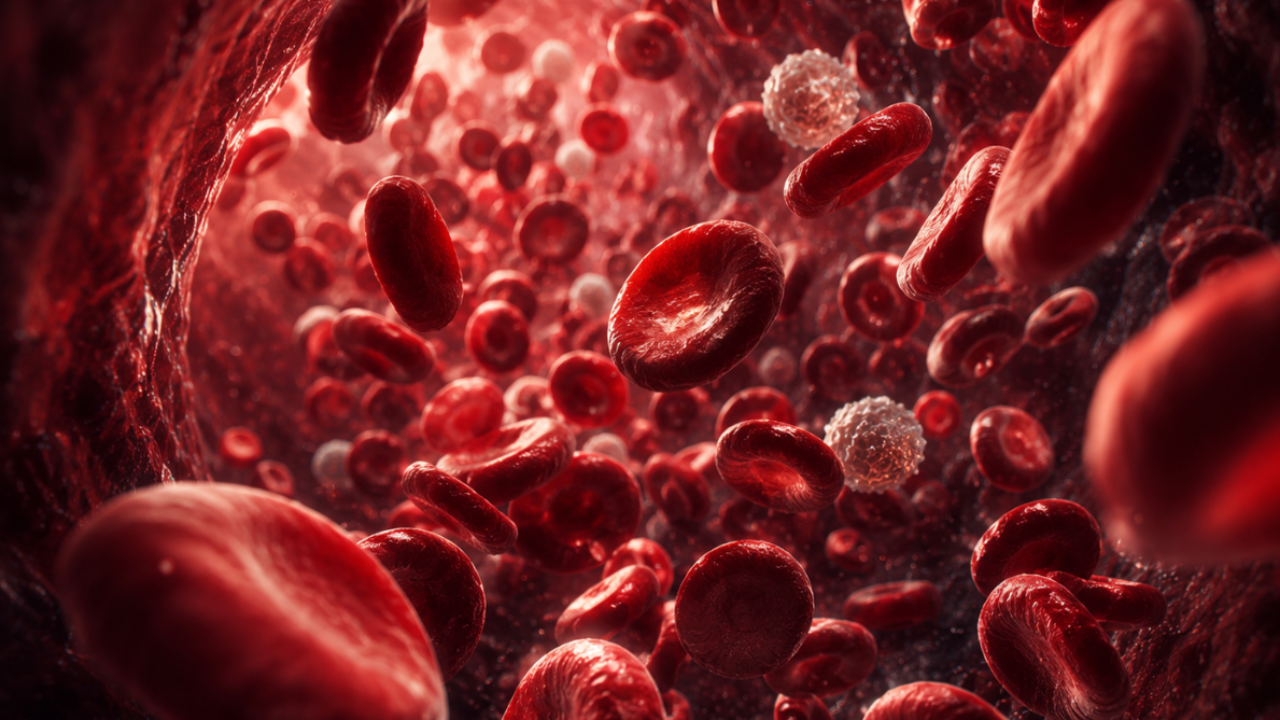
The small room smelled of antiseptic and ozone. A sharp, metallic ping echoed from the monitor beside the bed, a sound that measured out the remaining seconds of a Tuesday afternoon. On the mattress lay Sarah, a thirty-two-year-old mother of two, her face the color of skim milk. Every few minutes, her chest would heave, a desperate, shallow gasp for air that never seemed to satisfy her lungs. She was drowning on dry land. Her red blood cell count had plummeted to a critical low following an unexpected postpartum hemorrhage.
As a hematology researcher, I have watched this scene unfold more times than I care to admit. Yet, every single time, it strips away the sterile academic detachment built up over years of lab work. You look at a patient like Sarah, and you do not see a spreadsheet of laboratory values. You see a flickering lamp.
Then, the nurse arrived carrying a thick, pliable plastic bag filled with a deep, crimson fluid. She spiked the bag, cleared the line, and connected it to Sarah’s IV.
Within an hour, the transformation began. The ghostly pallor of her lips gave way to a flush of faint pink. Her breathing slowed, deepening into a steady, peaceful rhythm. The monitors stopped their frantic chiming. To the untrained eye, it was a routine medical intervention, a standard blood transfusion. But if you know what to look for, it was something far more profound. It was the invocation of a biological miracle that required three-quarters of a billion years to perfect.
We walk around every day treating our blood as a given. We think of it only when we scrape a knee or read a troubling lab report. We view it as a mere delivery system, a biological highway transporting oxygen from point A to point B.
That view is wrong. It is completely backward.
Your blood is not just a fluid. It is a living, flowing history book. Every drop coursing through your fingers right now contains a genetic narrative that stretches back long before the first dinosaur walked the Earth, back to a time when the world was nothing but a vast, silent ocean populated by microscopic blobs of slime. For centuries, science could see the final product, but we had no idea how the story actually started.
Recently, that changed. Evolutionary biologists finally tracked down the precise genetic spark that turned primordial water into human blood. The discovery does more than just solve a scientific parlor trick. It rewrites our understanding of our own survival.
The Invention of Inside
To understand what happened to Sarah, and what happens inside you every second, we have to look at a world without blood.
Go back 700 million years. The planet was a strange, alien water-world. Life existed, but it was incredibly simple. These were creatures like ancient sponges and soft-bodied mats of cells drifting in the currents. They did not need a circulatory system. They were so thin, so entirely exposed to the sea, that oxygen could simply drift through their outer membranes via passive diffusion. The ocean fed them directly. The ocean washed away their waste. They did not have an environment; they were the environment.
But this lifestyle came with a hard biological ceiling. You can only grow so large if you rely on the patience of drifting oxygen molecules. If a creature grew too thick, its inner cells would suffocate long before the oxygen could seep inward from the surface.
Life was trapped in a state of microscopic fragility.
Then came the Great Breakout. Evolution began experimenting with complexity, pushing cells to stack, layer, and bunch together into larger, more ambitious shapes. This created an immediate, existential crisis. The moment an organism became multi-layered, the cells locked deep inside its interior were cut off from the outside world. They were trapped in the dark, starving for oxygen, choking on their own metabolic garbage.
Imagine a crowded stadium where only the people sitting in the very front row can breathe, while thousands in the center suffocate. That was the bottleneck of multicellular life.
To survive, nature had to invent a way to bring the ocean inside.
This is not a poetic metaphor. It is a literal description of what happened. Our ancestors folded a piece of the ancient sea into their own bodies, trapping it behind barriers of tissue so they could carry it with them wherever they went. But you cannot just pump raw seawater through a complex body and expect it to work. Seawater holds very little dissolved oxygen. As animals grew larger and more active, moving from sluggish drifting to active hunting, they needed a specialized fluid that could carry vast amounts of gas under pressure.
They needed blood. Specifically, they needed a way to manufacture the specialized cells that make blood work.
The Mystery of the First Stem Cell
For decades, the search for the origin of blood centered on a specific type of cell called the hematopoietic stem cell. These are the master cells, the factory workers of your bone marrow. They are completely unformed, yet they possess the terrifyingly beautiful ability to transform into whatever your body needs at any given moment.
Need to fight off a sudden viral infection? These stem cells divide and mature into aggressive white blood cells, the infantry of your immune system. Cut your hand slicing an apple? They shift production to create platelets, rushing to the site to weave a biological mesh that stops the leak. Feeling faint at a high altitude where the air is thin? They churn out millions of red blood cells packed with hemoglobin to grab every stray molecule of oxygen available.
[Image of hematopoietic stem cell differentiation]
Every single cell in your circulatory system can be traced back to this single, ancestral lineage of stem cells. They are the fountain of youth within our bones.
But scientists were plagued by a frustrating, chicken-and-egg paradox. Where did these master cells come from? They do not just appear out of nowhere. In the embryonic development of a human being, or a mouse, or a fish, these blood-forming stem cells emerge from a very specific tissue: the endothelium, which is the smooth, microscopic lining of our blood vessels.
It is a bizarre process to watch under a microscope. During development, a group of ordinary-looking cells lining the inside of a blood vessel suddenly change shape. They detach from their neighbors, round up, and literally squeeze loose into the bloodstream, transformed into fully functional blood stem cells.
This transition is called the endothelial-to-hematopoietic transition. It is the exact moment blood is born in an embryo.
For years, researchers assumed this incredibly complex, highly orchestrated dance was a modern luxury. We figured it was something invented by advanced animals with backbones—vertebrates like us—millions of years down the evolutionary line. We assumed that simpler, spineless creatures did things differently, using cruder methods to move nutrients around.
We were looking in the wrong place.
The Breakthrough in the Mud
The breakthrough did not happen in a prestigious medical school or a high-tech human genomics lab. It happened by looking at an aggressively unglamorous creature that looks like a translucent, prehistoric thumb driving itself into the mud of the ocean floor.
Meet the amphioxus, or the lancelet.
[Image of an amphioxus lancelet]
These tiny, fish-like invertebrates have no brain, no eyes, and crucially, no real blood. They do not have hemoglobin. Their fluid is clear, carrying no red or white blood cells. They are living fossils, creatures that paused their evolutionary journey hundreds of millions of years ago, choosing to stay behind in the evolutionary mud while the rest of our lineage climbed out and built castles.
Because they have no blood cells, everyone assumed they lacked the machinery to make them. But a team of evolutionary biologists decided to look closer at how the lancelet develops its basic fluid channels.
They ran genetic sequencing on the tissues of these tiny creatures, looking for the specific molecular switches that control cell identity. What they found sent shockwaves through the scientific community.
Deep within the clear, bloodless vessels of the lancelet, they found the exact same genetic program running. They witnessed the lancelet's endothelial cells undergoing the exact same shape-shifting routine, detaching from the vessel walls and dropping into the fluid stream.
The lancelet was making blood stem cells. It just didn't have a use for them yet.
This means the entire, complex infrastructure for creating human blood was not invented by fish, or amphibians, or mammals. The blueprints were drawn up 700 million years ago, before bones even existed. The system was built as a prototype in a spineless, brainless creature buried in the sea floor.
It was an ancient piece of software, written for hardware that had not been invented yet.
The Cost of the System
When you see the data laid out on a screen, the elegance of it is breathtaking. But out here in the real world, away from the clean lines of evolutionary trees, this ancient system feels incredibly fragile.
Consider what happens when this 700-million-year-old machinery hitches.
Because our blood production is reliant on a continuous, frantic assembly line of stem cells dividing billions of times a day, it is highly vulnerable to corruption. If a single genetic typo slips into the code of one of those master cells, the assembly line jams. Instead of producing smooth, functional red cells or disciplined white cells, the marrow begins pumping out mutated, immortal clones that crowd out everything else.
We call that leukemia.
Or consider what happens when the body's iron supplies run dry. Hemoglobin, the specialized protein that allows red blood cells to latch onto oxygen, relies on a tiny atom of iron at its core to act as a molecular magnet. Without that iron, the red blood cells become small, pale, and hollow. They cannot hold their grip on the oxygen they carry.
We call that anemia.
That is what was happening to Sarah. Her system had run out of raw materials. Her ancient, deeply rooted biological machinery was spinning its wheels, desperately trying to manufacture the fluid of life, but it could not keep up with the deficit.
That is the terrifying paradox of our biology. We are walking around with a circulatory system engineered by half a billion years of trial and error, a system capable of adapting to deep-sea pressures and high-mountain peaks. Yet, a shift of a few milligrams of iron, or a single missing clotting factor, can bring the entire massive apparatus crashing down in a matter of hours.
We are masterpieces built out of glass.
The River Within
Sitting by Sarah's bedside, watching the crimson fluid slowly disappear into her vein, you realize how profoundly connected we are to the history of this planet.
We like to think of ourselves as separate from nature. We build concrete cities, climate-controlled apartments, and digital realities to isolate ourselves from the wild, chaotic world outside. We look at images of the ancient earth as something distant, an old movie that has nothing to do with us.
But you cannot truly separate yourself from the deep past when the deep past is currently pumping through your heart.
The saltiness of your tears, the moisture in your lungs, the specific balance of electrolytes in your plasma—it is all a curated sample of the ancient ocean, preserved and maintained by a genetic script written by a creature buried in primordial mud. You do not just live on Earth. A very specific, very old version of Earth lives inside you.
The transfusion bag was empty now. The nurse returned, quietly disconnecting the tubing and checking Sarah’s vitals one last time.
Sarah’s eyes fluttered open. The vacant, terrified look that had dominated her face for hours was gone, replaced by a quiet focus. She looked down at her hands, flexing her fingers as the warmth returned to her skin. She looked toward the window, where the late afternoon sun was casting long, amber shadows across the floorboards.
"I feel like myself again," she whispered, her voice still raspy but carrying a distinct, newfound weight.
She thought she was just thanking a blood donor and a medical team. She had no way of knowing she was actually celebrating the successful reboot of a 700-million-year-old engine, an ancient river that had traveled through deep time, through catastrophes and extinctions, through mud and bone, just to keep her alive for one more afternoon.
/i.s3.glbimg.com/v1/AUTH_5dfbcf92c1a84b20a5da5024d398ff2f/internal_photos/bs/2022/7/q/6M5eaAQBGuPVBPz0xKuQ/whatsapp-image-2022-12-24-at-17.52.03.jpeg)