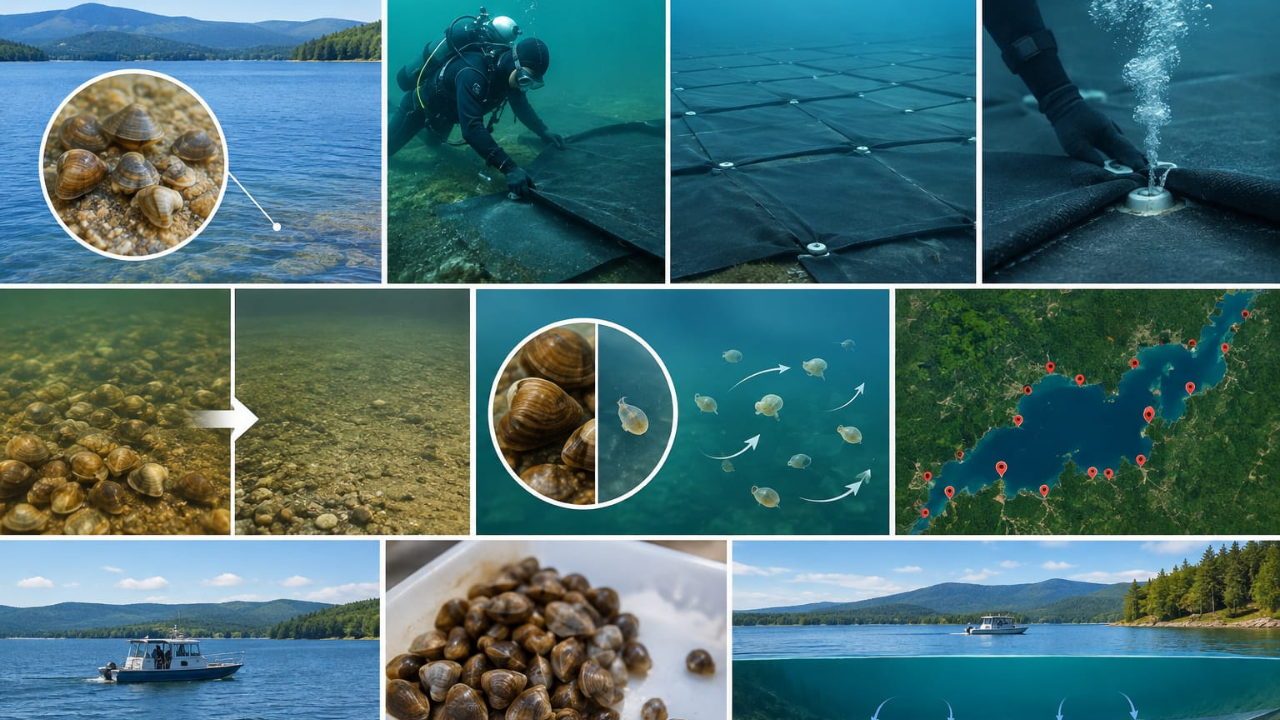
Fighting an invasive species in a pristine ecosystem is basically a masterclass in frustration. Back in 2011, environmental managers in New York faced a brutal reality check on Lake George. They deployed more than 700 benthic barrier mats across roughly five acres of the lakebed to suffocate an invading population of Asian clams. On paper, the strategy was bulletproof. Cut off the oxygen, trap the organisms, and wipe them out.
It worked brilliantly on a micro scale. Underneath those heavy mats, roughly 97 percent of the clams perished. Success seemed absolute for a brief moment. Yet, despite killing millions of clams in the targeted zones, the overall eradication effort missed the bigger biological picture. Within a few years, surveys revealed that the resilient invaders had quietly popped up across 27 separate locations in the lake.
The Mechanics of the Matting Experiment
Asian clams, known scientifically as Corbicula fluminea, aren't passive creatures. Native to southern Asia and Australia, these small bivalves reproduce at alarming rates and tolerate variable environmental stressors with ease. When they first showed up in Lake George around 2010, local agencies panicked for good reason. Dense colonies filter vast amounts of water, altering nutrient cycles, fueling unwanted algae blooms, and suffocating native mollusk populations that have spent centuries occupying the same niche.
The response was aggressive. Task force members laid down heavy rubber and synthetic mats, anchoring them with rebar and sandbags to pin down the lakebed. Divers installed monitoring ports in over 150 of these barriers to track dissolved oxygen and ammonia levels every week. The goal was total physical isolation. Starve the bivalves of oxygen and let chemistry do the dirty work.
And honestly, the initial numbers looked amazing. When divers pulled back the first sections of fabric, they found thick layers of dead shells. The treatment cleared localized zones effectively. But nature rarely cooperates with a clean spreadsheet.
Why Eradication Collapsed Under the Surface
Killing 97 percent of a population sounds like a win until you realize the sheer math of biological reproduction. A single surviving cluster can release hundreds of microscopic, buoyant juveniles into the water column. These tiny travelers drift effortlessly on currents, bypassing physical barriers entirely.
Even worse, the mapping data showed that treating one spot often pushed boaters, anglers, or natural currents to distribute remnants elsewhere. Sites that checked out clean one year would mysteriously host new colonies the next. The task force realized that trying to blanket an entire lakebed with rubber barriers wasn't just logistically punishing—costing hundreds of thousands of dollars for minor fractions of coverage—it was ecologically unsustainable.
By 2016, officials pumped the brakes on the blanket barrier treatments. They admitted that chasing every scattered pocket with physical barriers wasn't practical over the long haul.
The Real Lesson for Aquatic Conservation
If you think this is just a local New York story, look closer at freshwater bodies across North America. Invasive species exploit human hubris. We look for a mechanical fix—a giant band-aid like a synthetic mat—hoping to force an ecosystem back into balance overnight.
Total eradication is rarely realistic once a fast-breeding organism gains a foothold. Management shifts from winning a war to playing endless defense. Protecting a water body now relies heavily on early detection, rigorous boat washing stations, and preventing transport between watersheds rather than trying to vacuum clean the lake floor after the fact.
Stop treating natural water bodies like controlled laboratory tanks. Once an invasive bivalve adapts to a new home, getting rid of it completely becomes nearly impossible. Success isn't about total elimination anymore; it's about containment, vigilance, and accepting that some ecological disruptions change a landscape permanently.