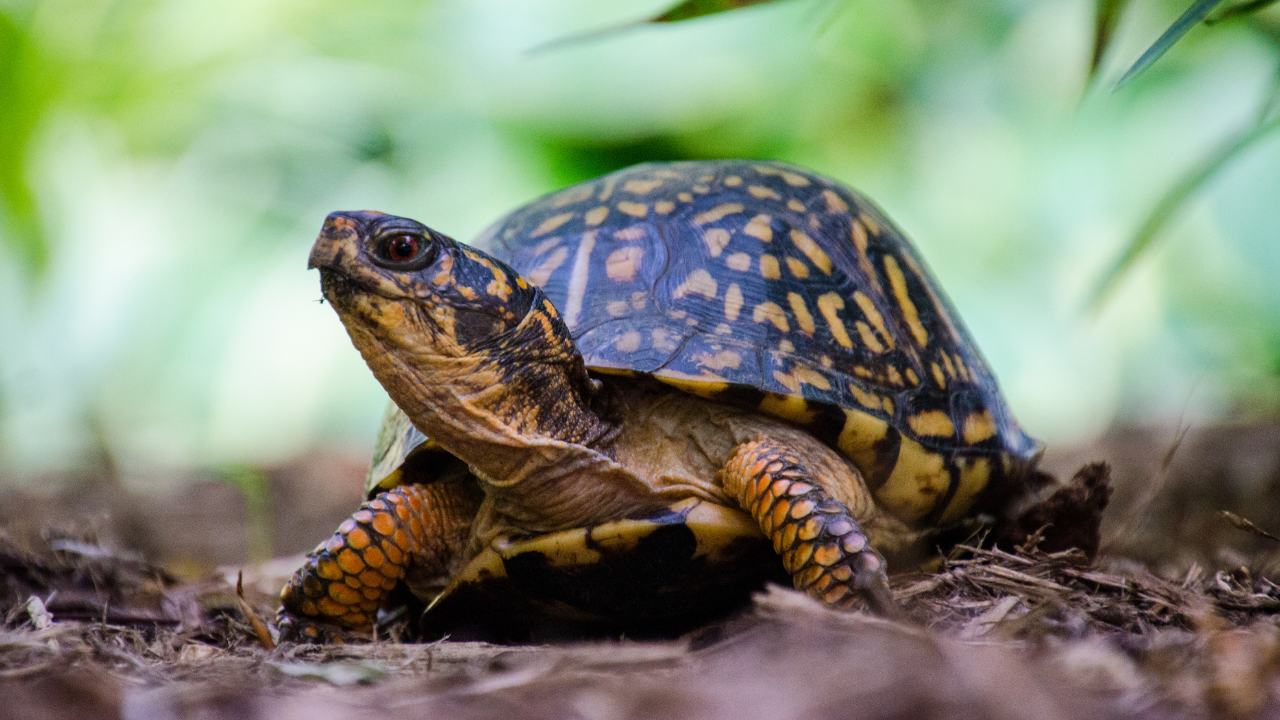
The beach at night does not belong to the ocean. It belongs to the shadows that crawl across it on six legs, sliding over the cool sand with calculated, ancient precision.
To the casual midnight beachgoer, the barrier islands of the mid-Atlantic are a tranquil stretch of wind-sculpted dunes and rhythmic surf. To a mother diamondback terrapin, they are a maternity ward. She drags her heavy shell ashore, her webbed feet carving a pair of parallel furrows through the grains. She digs with her hind legs, drops a clutch of leathery eggs into the earth, covers them with meticulous care, and vanishes back into the salt marsh, leaving behind a fragile promise wrapped in calcium.
She thinks she has hidden them. She is wrong.
Down the coast, beneath the amber glare of a portable work light, researchers at the Smithsonian Environmental Research Center are playing a high-stakes game of hide-and-seek against a ticking clock and an army of invisible thieves. They are armed with an arsenal that sounds like the inventory of a marine biologist turned rogue detective: medical X-ray machines, plastic cups, and precisely two hundred and sixteen yards of thin, unassuming thread.
They are not just studying turtles. They are trying to catch a thief in the act.
The Mathematics of Survival
Consider what happens next beneath the surface of the dunes.
A turtle nest is not a random drop. It is an incubator, buried six to eight inches deep, holding anywhere from eight to a dozen eggs. To us, the sand looks uniform. To a raccoon, a fox, or an opossum, the dune is a grand buffet written in the language of scent. The disturbed soil, the trace organic matter, the faint ammonia of the mother's excavation—they all broadcast a dinner bell that carries across the marshlands.
When the Smithsonian team set out to monitor these nests, they did not just want to count hatchlings. They wanted to know the exact attrition rate. The numbers they uncovered are staggering, brutal, and quietly heartbreaking. Out of sixteen documented nests meticulously tracked by the researchers, thirteen were raided.
That is an eighty-one percent failure rate. Before a single hatchling even knows the sun exists, more than four out of five nests are systematically dug up and devoured.
This is the hidden crisis of the barrier islands. We celebrate the successful nesting seasons, the heartwarming newspaper photos of tiny reptiles scuttling toward the surf. We rarely talk about the massacre happening in the dark, just inches below the footprints of vacationers.
Inside the Smithsonian Field Lab
To track this carnage without disturbing the natural ecosystem, the researchers had to get inventive. You cannot post a guard over every square foot of sand. You cannot station a human observer to watch a nest for sixty days straight without altering the behavior of the very predators you are trying to observe.
So, they turned to technology borrowed from hospitals and laboratories.
They use portable X-ray equipment to verify the contents of suspected nests without cracking open the earth. They slide tiny plastic cups into the sand around certain experimental sites to monitor micro-movements and temperature fluctuations. But the most ingenious tool in their kit is remarkably low-tech: the thread.
Two hundred and sixteen yards of it.
It acts as an invisible tripwire network across the nesting grounds. When a predator comes sniffing, digging, and tearing through the sand, the thread snaps. It creates a mechanical record of intrusion. It tells the researchers not just that a nest was taken, but when, and often, by the signature of the disturbance, who.
Imagine standing on that wind-swept beach at two in the morning. The air smells of salt and rotting kelp. The beam of a red-tinted headlamp cuts through the mist, illuminating a researcher kneeling in the sand, gently spooling out a strand of thread no thicker than a spider's web. They are tying the fate of an entire species to geometry and tension. Every snapped thread is a data point in a tragedy.
Why the Balance is Breaking
Why are thirteen out of sixteen nests getting wiped out? Is this just nature running its course?
Not quite. Nature has been thrown violently out of whack, and we built the fulcrum.
Raccoons and red foxes thrive on the edges of human civilization. Dumpsters, suburban backyards, and roadkill provide an endless, reliable calorie surplus for mammalian predators. Their populations have exploded far beyond what historical, wild ecosystems ever supported. When these hyper-abundant predators spill over into protected coastal parks and wildlife refuges, they find a concentrated, defenseless food source buried in the sand.
The diamondback terrapin didn't evolve alongside trash cans and suburban sprawl. They evolved alongside natural predators whose numbers were kept in check by apex carnivores and harsher winters. Today, the terrapin faces a gauntlet that tilts further against its survival with every passing year.
The scientists at the Smithsonian are not just collecting data for a dusty academic journal. They are sounding an alarm. Every raided nest represents a generation wiped out before it draws a breath. If eighty-one percent of the next generation vanishes before hatching, the mathematics of extinction become terrifyingly simple.
The Weight of a Single Egg
It is easy to look at a reptile and feel disconnected. They do not purr. They do not have expressive eyes. They do not nurse their young. A terrapin is ancient, armored, and silent.
Yet, watch one on land for a moment. Watch the heavy, rhythmic heave of her shell as she drags herself up a steep dune, exhausted, driven entirely by an ancient biological imperative that predates human history by tens of millions of years. She does not know what a raccoon is. She does not know what an X-ray machine is. She only knows that this specific patch of sand feels right, that the temperature is right, that her lineage depends on the next twenty minutes.
When that nest is dug up three nights later by a scavenger fattened on human garbage, something irreplaceable is lost. Not just a statistic. Not just a data point on a Smithsonian spreadsheet.
A line that stretched back through the Miocene epoch is snapped. Just like the thread in the sand.
As the fog rolls back over the salt marshes and the first pale streaks of dawn turn the Atlantic from black to bruised steel, the beach goes quiet again. The researchers pack up their gear—the X-ray plates, the plastic cups, the remaining spools of thread. They leave the dunes looking untouched, serene, and entirely peaceful.
And beneath the sand, the waiting continues.