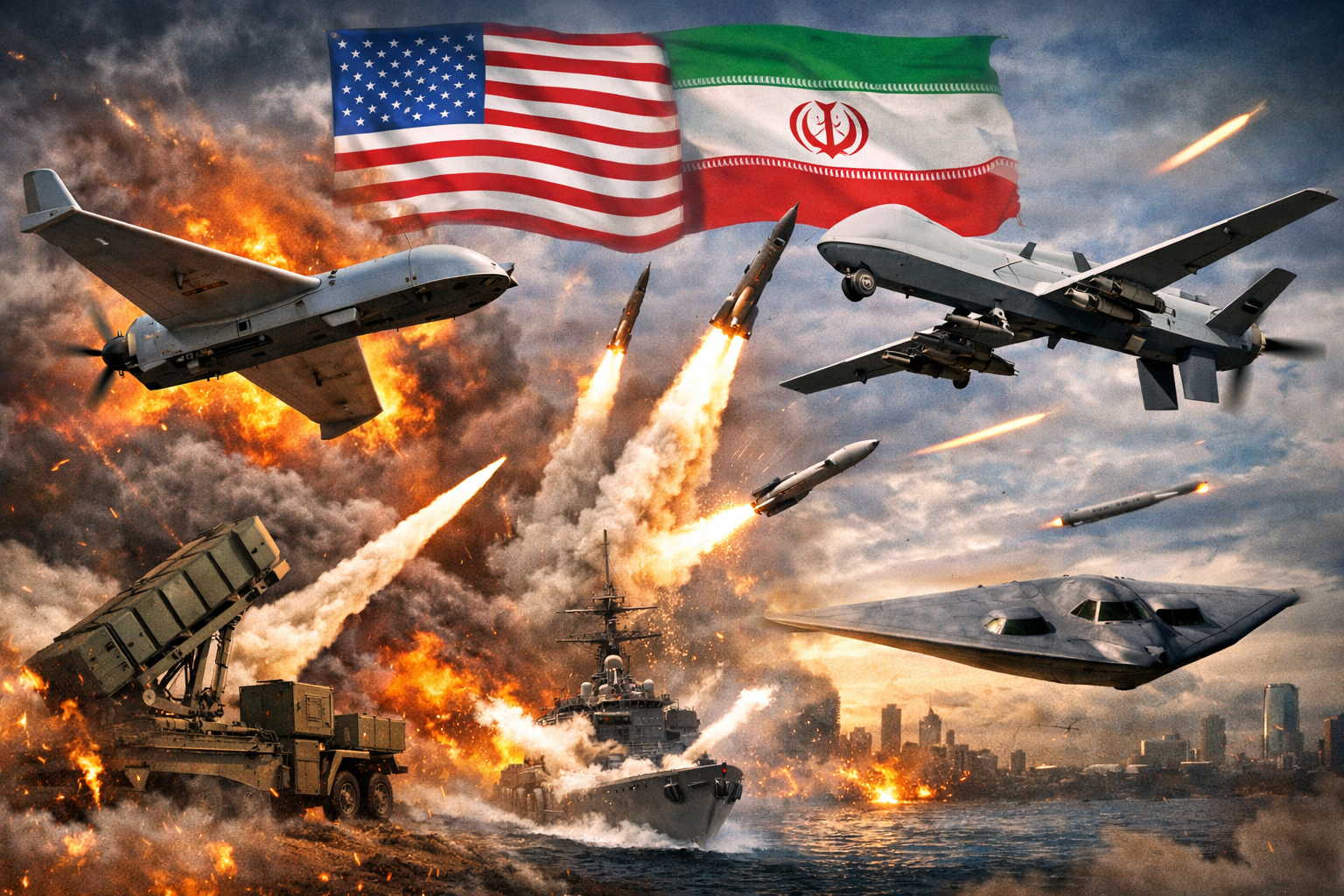
The arithmetic of modern warfare has turned suicidal. In the current escalation of Operation Epic Fury, a single Iranian Shahed-136—a "flying lawnmower" built with off-the-shelf parts and a moped engine—costs roughly $20,000. To stop it, the United States and its partners are firing Patriot interceptors that cost roughly $4 million per shot.
This isn't just a military conflict; it is a financial hemorrhage. While the Pentagon showcases its ability to fly B-2 Spirit stealth bombers halfway around the world to strike "missile cities" buried under Iranian granite, the actual strategic leverage is shifting toward the side that can afford to lose the most hardware. For the first time since the Cold War, the U.S. military is facing an adversary that has successfully decoupled lethality from cost.
The Lucas Pivot and the Death of Sophistication
Washington has finally admitted its high-tech addiction is a liability. The recent deployment of the Low-cost Unmanned Combat Attack System (LUCAS) marks a humiliating but necessary admission by the Air Force. The LUCAS is, for all intents and purposes, an American-made clone of the Shahed. Operated by the newly activated Task Force Scorpion Strike, these drones represent a pivot from the "silver bullet" philosophy—where every asset is precious and irreplaceable—to a "disposable" doctrine.
The logic is simple. You cannot fight a swarm with a sniper rifle. When Iran or its regional proxies launch volleys of 50 or 100 drones, they aren't looking for a "fair fight." They are looking to saturate the radar of a $13 billion aircraft carrier like the USS Gerald R. Ford. If a $50,000 drone forces a $2 billion destroyer to expend its entire magazine of Standard Missile-2 interceptors, the drone has won without ever exploding.
The Stealth Bomber's Final Stand
The B-2 Spirit remains the most terrifying weapon in the American inventory, but its role has changed from a primary tool to a specialized surgeon. Recent strikes on Iranian nuclear facilities and underground missile silos required the 30,000-pound Massive Ordnance Penetrator (MOP). No other aircraft can carry it; no other aircraft can deliver it unseen.
However, the fleet is dangerously thin. With only 19 aircraft in the entire inventory, every sortie is a strategic gamble. If a single B-2 were lost to a lucky shot or a mechanical failure over the Zagros Mountains, it would represent a loss of roughly 5% of the nation’s total deep-penetration capability. The B-21 Raider is being fast-tracked for a reason: the U.S. has realized that 19 "perfect" planes cannot hold a front against an adversary that produces thousands of "good enough" missiles.
Under the Radar: The New Asymmetric Fronts
While the world watches the sky for stealth bombers, the real damage is happening at sea level and in the digital architecture of the Gulf. Iran’s strategy focuses on "economic attrition."
- The Data Center Strike: In a chilling expansion of the battlespace, Iranian drones recently targeted Amazon Web Services (AWS) data centers in the UAE. By knocking out regional cloud infrastructure, they didn't just hit a military target; they paralyzed the digital economy of an entire nation. People couldn't pay for groceries or access banking apps.
- The Radar Hunt: Iranian ballistic missiles, specifically the Fateh and Zolfaghar variants, have successfully targeted the "eyes" of the U.S. defense network. Satellite imagery has confirmed the destruction of AN/TPY-2 radar systems in Jordan and Qatar. These systems are the lynchpin of the THAAD and Patriot batteries. Without them, the multi-million dollar interceptors are blind.
- The Tanker War 2.0: The use of the Fattah-2 hypersonic missile against commercial shipping near the Strait of Hormuz has sent insurance premiums into the stratosphere.
The Interceptor Crisis
The most significant overlooked factor in this war is the industrial capacity for replenishment. The U.S. can produce a handful of Patriot missiles a month. Iran, using a decentralized network of workshops and "missile cities," can produce hundreds of drones and short-range missiles in the same timeframe.
We are seeing the exhaustion of the "interceptor stockpile." When a THAAD battery in Jordan is depleted, it cannot be refilled by a local warehouse. It requires a massive logistical chain stretching back to the United States—a chain that is currently being strained by simultaneous demands from Eastern Europe and the South China Sea.
The Strategy of the Weaker Power
Iran is not trying to win a decisive naval battle in the Persian Gulf. They know the F/A-18 and F-35 jets flying off the USS Abraham Lincoln would eviscerate their aging Air Force in minutes. Instead, they are forcing the U.S. to play a game of "defensive exhaustion."
By targeting civilian infrastructure and energy hubs like the Rumaila oil field in Iraq, they force the U.S. to spread its limited air defenses thin. Every Patriot battery moved to protect an oil refinery is one fewer battery protecting a U.S. airbase. This creates gaps. In those gaps, the Iranian "missile umbrella" becomes effective, protecting their own assets while they wait for the political or economic will in Washington to snap.
The brutal truth of this conflict is that technology has reached a point of diminishing returns. The side with the most expensive weapons is currently the side most vulnerable to the high cost of victory.
Would you like me to analyze the specific production bottlenecks for the B-21 Raider to see if it can actually solve this "mass" problem before the end of the decade?