The dirt road leading toward the Little Bighorn River doesn’t care about anniversaries. It kicks up the same thick, chalky dust in the shimmering heat of June that it did when the planet belonged to different men. When you step out of a truck onto the prairie grass here, the first thing that hits you is the silence. It is an immense, heavy quiet that presses against your eardrums, broken only by the dry rattle of cicadas and the occasional, sudden snap of a gusting wind.
To the rest of the world, this place is etched into textbooks under a singular name: Custer’s Last Stand. It is treated as an isolated tragedy, a dramatic tactical failure during America's centennial summer where a flamboyant Civil War hero named Lieutenant Colonel George Armstrong Custer and his divided Seventh Cavalry rode into an ambush. But names carry their own architectures of truth. To the descendants of the Lakota, Northern Cheyenne, and Arapaho who fought here, these rolling slopes are known as Greasy Grass, named for the slick, rich texture of the riverbank forage. Also making news in related news: The Long Wait for a Quiet Sky.
This week marks exactly 150 years since that sweltering afternoon on June 25, 1876. To look across the ridges now is to witness an unraveling of time itself.
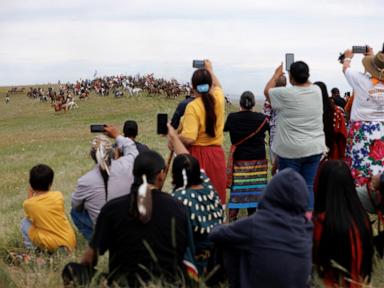
Hundreds of people have gathered to pitch a canvas city of tepees along the riverbanks. They traveled from the reservation lands of the Dakotas, from Wyoming, and from as far away as Washington state. They did not come to gaze at marble markers or read bronze plaques erected by the federal government. They came to ride. Additional information regarding the matter are detailed by The New York Times.
The Thunder Beneath the Ridges
A lone drumbeat starts before the sun clears the horizon. William Good Bird, a traditional singer from the Spirit Lake Dakota Nation, wakes the sleeping camp with a voice that feels less like performance and more like a natural extension of the soil. The rhythm is slow, heavy, mimicking the heartbeat of a horse at rest.
By afternoon, that heartbeat accelerates into a frenzy.
Several hundred horse riders charge up the steep, yellowed hillsides, their mounts kicking up plumes of dust that catch the harsh Montana sunlight. The riders whoop and yell, their voices cutting through the dry air just as their ancestors' voices did a century and a half ago. Elders watch from the shade of trucks, their elaborate feathered headdresses trembling slightly in the breeze as the young men circle the hillcrest.
To an outsider, it looks like a spectacle. To the people on the horses, it is a metabolic necessity.
Consider a hypothetical teenager sitting on one of those charging horses today. Let’s call him Joseph. Joseph grew up in a community where the local high school dropout rate climbs past forty percent, where the grocery store is an hour's drive away, and where the language of his grandparents is slowly evaporating into history. For most of the year, Joseph is told, implicitly and explicitly, that his culture exists in the past tense.
But when his thighs grip the flanks of a bareback horse flying up a ridge at Greasy Grass, the past tense dissolves. The wind in his face is the exact same wind that hit Crazy Horse. The dust in his throat is the same dust that choked Custer’s retreating soldiers.
At the Standing Rock Sioux Reservation, just across the state line, the celebration manifests as oskáte—a traditional gathering dedicated to oral histories, victory songs, and tribal dancing. They are holding horse races specifically to honor what they call the "horse nation." It is a recognition of the four-legged allies that carried their ancestors to victory, an acknowledgment that human survival on these plains has always been a shared endeavor between species.
The Illusion of a Ending
History books love an ending. They treat the Battle of Greasy Grass as a climactic finale, a singular explosion of Native resistance before the inevitable closing of the frontier.
The reality was far more punishing.
The news of Custer’s total defeat reached the eastern seaboard exactly as the United States was celebrating its hundredth birthday. The shock wave was psychological and immediate. A nation drunk on the myth of its own manifest destiny could not comprehend how its elite cavalry had been systematically dismantled by a coalition of nomadic tribes.
The retaliation was swift and bureaucratic. What weapons couldn't achieve, starvation did. Within five years of their greatest military triumph, the allied tribes were systematically hunted down, their buffalo herds annihilated, and their people forced onto reservations—then called agencies. Crazy Horse was killed in 1877 with a bayonet through his kidney. By 1881, sitting bull was forced to bring his starving people in from Canadian exile to surrender.
There is a story passed down through the Hunkpapa band of the Oceti Sakowin that reframes that surrender. Jon Eagle Sr., a former Standing Rock tribal historic preservation officer, carries the narrative of his ancestors. He notes that the history books claim Sitting Bull surrendered out of brokenness. But oral history says otherwise.
When the great leader finally walked into the agency, he looked at his young son, Crow Foot. He did not speak of defeat; he spoke of a shifting landscape.
"My boy," Sitting Bull said, "if you live, you can never be a man in this world because you can never own a gun or a pony."
He wasn't admitting military defeat. He was diagnosing a profound, systemic shift in the rules of survival. He understood that his children and grandchildren would have to learn to fight on an entirely different kind of battlefield—one made of ink, paper, assimilation policies, and boarding schools designed to strip them of their names.
The Weight of Two Hundred and Fifty Years
As the rest of America prepares to commemorate 250 years since the signing of the Declaration of Independence, the atmosphere at Greasy Grass remains complicated. For many here, the two anniversaries sit uncomfortably beside one another.
Jim Real Bird, a Crow tribal member who coordinates the annual battle reenactments, looks out over the wide-open grassland with a weathered squint. To him, the upcoming national sestercentennial isn't a celebration. It is a mathematical ledger of endurance against policy. It represents two and a half centuries of survival despite a government that spent a significant portion of that time attempting to erase their existence.
The survival is literal. Jon Eagle Sr.’s great-great-grandfather, Sunka, fought on this very dirt 150 years ago. His father, Charging Thunder, was there too. When Eagle stands on the ridge today, he isn't reading about historical figures. He is walking through his family tree.
The true victory being commemorated this week isn't the tactical annihilation of the Seventh Cavalry. It is the fact that the descendants of the victors are still breathing, still singing in their own tongue, and still riding horses across the same grass.
Theresa Long Turkey, a member of the Lower Brule Sioux Tribe who traveled from South Dakota to camp by the river, describes the annual gathering as "fuel for the year." It is a spiritual reset, a brief window where the modern fractures of reservation life—the poverty indices, the historical trauma, the quiet anxieties of the 21st century—are drowned out by the thunder of hooves and the steady, communal thump of the drum.
The afternoon sun begins its long, slow descent toward the Big Horn Mountains, painting the coulees in deep purple shadows. The white stone markers showing where Custer's men fell still dot the hillsides like old bone fragments. They are static, cold, and permanent.
But down by the river, the tepee smoke rises, sweet and pungent with sage. The horses are led to water, their chests still lathered with sweat, their hooves leaving fresh, deep impressions in the slick mud. The markers belong to the dead, but the grass still belongs to the living.