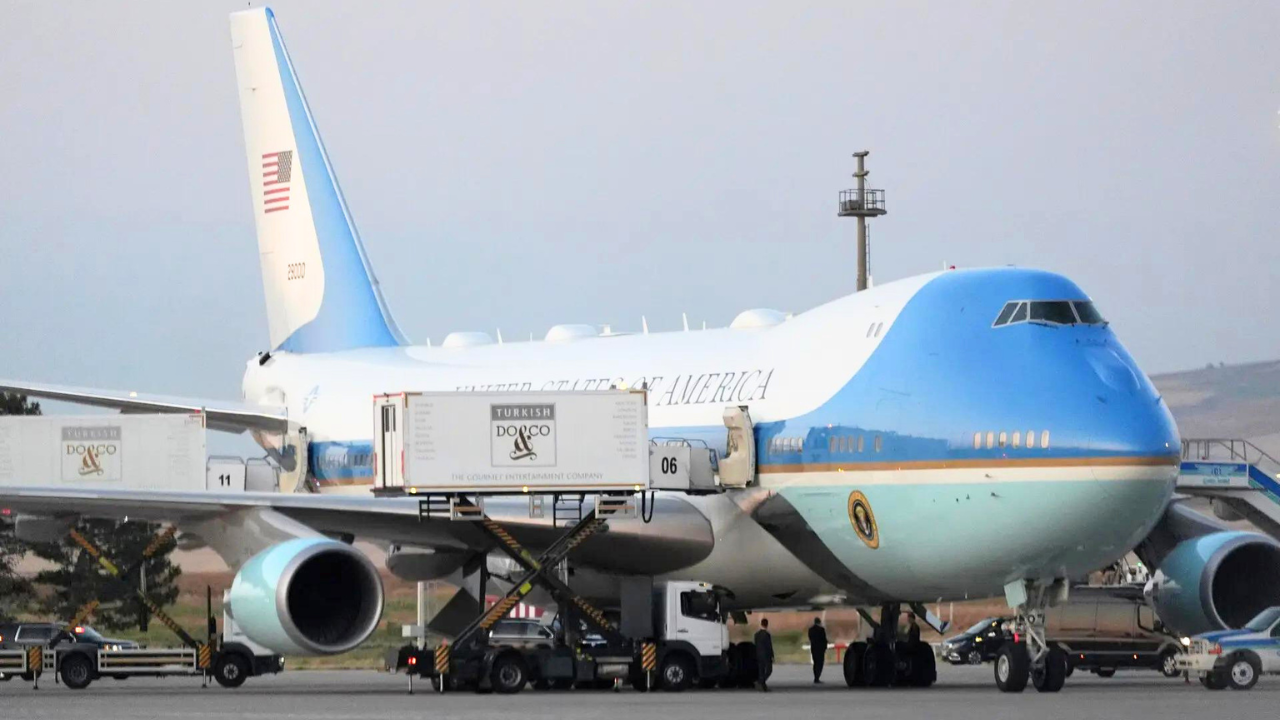
Turkey spent eight months and $120 million widening, lengthening, and completely overhauling Etimesgut Airport in Ankara for a single primary objective to safely land the new, Qatari-gifted Boeing 747-8 serving as Donald Trump’s interim Air Force One. Yet, as the July 2026 NATO summit drew to a close and geopolitical tensions flared along the Turkish-Iranian border, the gleaming $400 million flying palace sat practically vacant on the freshly paved tarmac. The American president did not board it. Instead, he slipped out of Turkish airspace in a 35-year-old legacy VC-25A, leaving his brand-new transport to fly nearly empty to a British airbase.
This sudden, unscripted aircraft swap exposed a glaring reality behind the scenes of international diplomacy. Substantial infrastructure investments and grand political gestures cannot override basic military necessity. While the Turkish government successfully pulled off an extraordinary engineering feat to roll out the red carpet, the plane itself lacked the critical defensive machinery required to operate in a high-risk theater. Meanwhile, you can read other events here: Inside the Kashmir Media Crackdown Nobody is Talking About.
The Physics of Diplomatic Egos
Etimesgut Airport was never designed to host the heaviest commercial airliners in the world. Originally a modest military airfield operating under the airport code ANK, its runway was too short, its taxiways too narrow, and its aprons entirely inadequate for modern wide-body diplomatic fleets. When Ankara was selected to host the high-stakes NATO summit, Turkish aviation authorities faced an immediate crisis of scale. Dozens of heads of state were arriving, but none brought a machine as demanding as the modified Boeing 747-8i.
The aircraft is a physical anomaly in the world of VIP transport. Stretching over 76 meters in length with a sprawling 68.4-meter wingspan, it represents the absolute ceiling of commercial aviation dimensions. It is significantly larger than the aging Boeing 747-200B models that have carried American presidents since the George H.W. Bush administration. At its maximum takeoff weight, the plane scales a staggering 442 tonnes. To explore the bigger picture, check out the detailed analysis by The New York Times.
These dimensions push the aircraft squarely into the International Civil Aviation Organization’s Aerodrome Reference Code F. This is the strictest and highest infrastructure tier in existence, shared almost exclusively with the double-decker Airbus A380. Most international gateways operate on Code E standards. To bridge this structural gap, Turkish engineers had to work around the clock for nearly three quarters of a year.
The engineering hurdles were compounded by Ankara’s natural geography. The city sits roughly 808 meters above sea level. In the intense heat of a Turkish summer, high altitude creates thin, low-density air. Thinner air robs aircraft engines of vital thrust and reduces the lift generated by the wings. To get a fully fueled, intercontinental jumbo jet safely airborne under these conditions, a pilot needs an immense stretch of asphalt to build up momentum.
Contractors tore up the old 2,450-meter runway, extending it to a full 3,000 meters to provide an adequate safety buffer for long-haul departures. They widened the strip from 42 meters to 60 meters. This massive expansion ensured that the jet's outer engines would not hang over dirt shoulders, sucking up dangerous debris, and gave the flight crew adequate room to maneuver without threatening nearby taxiways or lighting arrays. Alongside the runway overhaul, workers laid down a massive 160,000-square-meter aircraft apron capable of parking 44 separate state aircraft, built modernized protocol lounges, and installed advanced instrument landing systems. Turkey had successfully built a custom gateway fit for the ultimate symbol of American executive power.
The Secret Compromises of the Bridge Fleet
To understand why this $120 million runway was ultimately abandoned by the very president it was built for, one must look at the convoluted origin of the aircraft itself. The Boeing 747-8i was never supposed to be an interim Air Force One. It began its life as an ultra-luxury VVIP transport for the Qatari royal family. In a sudden diplomatic maneuver, Qatar gifted the $400 million aircraft to the United States.
For the White House, the timing seemed immaculate. The official program to replace the aging presidential fleet, known as the VC-25B project, has been trapped in a corporate quagmire for years. Boeing’s fixed-price contract has resulted in over $5 billion in development costs, severe labor shortages, and chronic technical delays. With delivery pushed back to mid-2028 at the earliest, there was a very real scenario where the current administration would finish its term without ever stepping foot inside a upgraded command plane.
The Qatari gift offered a shortcut. The administration accepted the plane as a bridge aircraft, bypassing the traditional procurement timeline. Defense contractor L3Harris Technologies was tasked with a high-speed retrofit to bring the luxury liner up to government standards, painting it in a bold new navy, red, and white livery chosen directly by Trump.
But high-speed defense contracting always demands a sacrifice.
To deliver the bridge aircraft to the tarmac in time for international travel in 2026, the U.S. Air Force deliberately omitted some of the most complex engineering modifications slated for the permanent fleet. The Pentagon publicly insisted that the plane met all essential safety and secure communication thresholds. Aviation analysts, however, quickly noticed something amiss. Close-up photographs of the newly unveiled jet revealed a startling lack of specialized antenna humps, optical sensors, and directional infrared countermeasure turrets that define the exterior of a true military-grade command post.
The plane was essentially a beautifully painted corporate lounge equipped with secure radios, lacking the deep systemic shielding against electromagnetic pulses or advanced missile tracking defense systems that protect a president in hostile skies. It was an aircraft built for domestic photo opportunities and benign travel, suddenly thrust into the volatile reality of Mediterranean geopolitics.
When Geometry Collides with Geopolitics
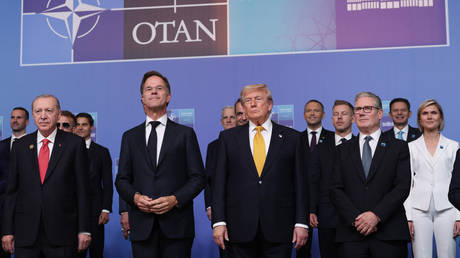
The NATO summit in Ankara was meant to showcase Western unity, but the physical environment outside the secure briefing rooms quickly deteriorated. Just as world leaders gathered, the United States military launched retaliatory strikes against targets in Iran following escalating attacks on commercial shipping lanes. Turkey shares a direct, mountainous land border with Iran.
Suddenly, flying the American president out of an airport located just a short flight from an active conflict zone became an operational nightmare for the Secret Service and the Air Force’s Presidential Airlift Group.
Under normal circumstances, the massive size of the Qatari-gifted 747-8 makes it a conspicuous target. Without full-spectrum missile defense systems, flying it over a region bristling with advanced anti-aircraft batteries and active military radar was deemed an unacceptable risk. The old, baby blue VC-25A backup plane, which had quietly trailed the main entourage to Turkey, suddenly became the only logical choice for the trip home. It was old and cramped by comparison, but it possessed decades of battle-tested electronic warfare suites, chaff dispensers, and flares capable of spoofing incoming heat-seeking missiles.
When the summit concluded, the president covered the security retreat with classic media misdirection. He announced on social media that he was flying home on the legacy aircraft for old time’s sake, claiming the new plane was simply being sent ahead to Royal Air Force Mildenhall in Britain so American service members stationed there could tour the magnificent machine.
The reality on the ground told a far different story. While other world leaders departed Ankara with their standard transponders active and visible to civilian flight trackers, the legacy Air Force One vanished from public tracking screens immediately after rolling down Etimesgut's new 60-meter-wide runway. The crew had blacked out its transponder—a defensive protocol reserved strictly for high-threat environments.
The glittering new 747-8, the very plane that dictated a $120 million infrastructure race across eight months of intense Turkish construction, departed separately. It flew through safer corridors, largely empty of passengers, landing in the United Kingdom where Trump eventually reboarded it once out of reach of regional missile threats.
The extensive overhaul of Etimesgut Airport remains a permanent monument to an unfulfilled logistical ambition. Turkey proved it could move mountains, spend fortunes, and redesign an entire aviation hub in record time to accommodate the sheer physical presence of the world's most demanding aircraft. Yet, no amount of newly poured concrete could compensate for a fast-tracked defense contract that left the world's most famous plane vulnerable to the harsh realities of a nearby border war.